by Oscar O’Sullivan
How can a film so massive, so utterly bloated with money and special effects and action, feel so incredibly slight? So impermanent, insignificant, intangible? My main impression of Marvel’s latest effort to course correct was that it felt mercifully brief, coming in just under two hours and feeling even less than that. A back-handed compliment, to be sure, but the only defence I could seriously mount for a film that seems completely disinterested in its own existence. That fast pace can be attributed to having a plot that never seems to truly begin, with every new scene seeming like the turning point that might finally kick things into gear – it’s not until we are suddenly thrust into the obvious climax that it becomes apparent how much time has simply drifted away without our really registering a single important moment or piece of information. To call this terrible would be an exaggeration, and it’s certainly not as aggressively infuriating as something like Deadpool & Wolverine or two-thirds of the Ant Man films, which plunge to the depths of awful filmmaking while wearing their franchise identities as a simpering, self-important shield. Indeed, Captain America: Brave New World seems like a desperate admission that the jig is up for easy nostalgia, as it bets the farm on people’s memory of and affection for the long-ignored and critically panned Incredible Hulk. What series of executive decisions lead to Marvel hinging their long-overdue course-correction on a direct continuation of the franchise’s biggest early fumble? Why does it bear almost no resemblance, whether in tone, structure or style, to the three Captain America films that preceded it? And why oh why was the entire marketing campaign dedicated to spoiling the one and only major twist in the story? We will inevitably have these answers when behind-the-scenes stories begin to trickle out, but until then we can only take the film as it is – if we can even determine what that means.
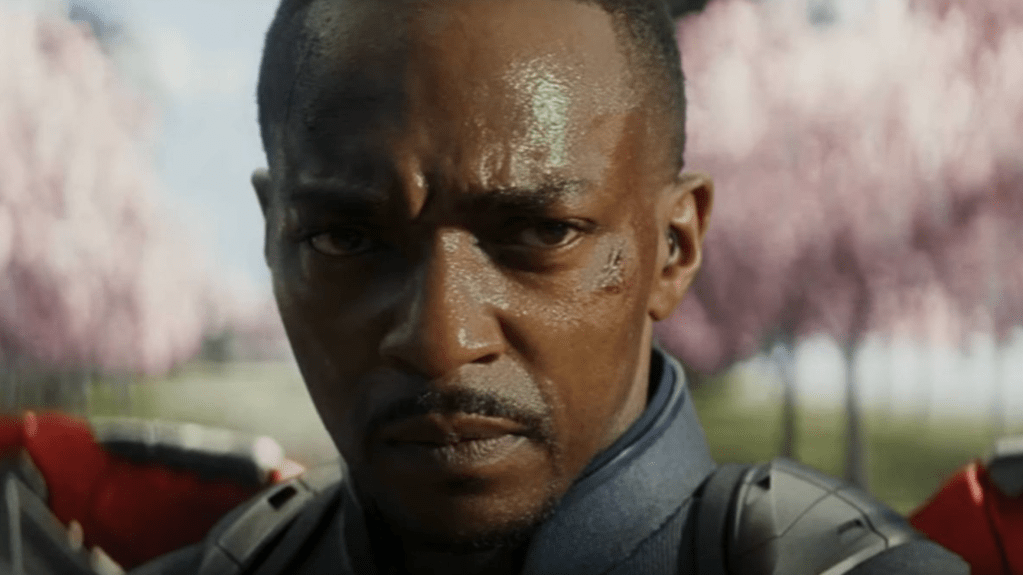
For those of you out there who have fallen out of step with the MCU’s increasingly dense plotting, allow me to clue you in – this is (nominally) a sequel to 2021’s The Falcon and the Winter Soldier, a series that was the best of Marvel’s Disney+ efforts. That show had a generous six-and-a-half hour window to prove that Anthony Mackie’s Sam Wilson was ready to graduate from supporting act to fully-fledged lead, which it achieved with flying colours. Wilson’s struggles with self-doubt and eventual acceptance of the Captain America mantle made for compelling drama and comfortably set the stage for him to headline his own film – so why has it taken four years to get that venture off the ground, and why does Captain America feel like an afterthought when his name is on the marquee? Our hero has a clearly defined goal – to clear the name of his friend Isaiah Bradley (Carl Lumbly, giving perhaps the only truly good performance in the film) who has been caught up in a mysterious scheme to assassinate the President of the United States, Thaddeus “Thunderbolt” Ross (Harrison Ford). What Wilson does not have is a character arc of any sort. He begins and ends the film in the same place, with the only change of heart he makes being the decision to reform the Avengers after being hesitant before. He starts out as a willing ally of the U.S. government, expresses a desire to mend bridges between himself and Ross, and nothing that happens during the film challenges or shakes that conviction.
Comparing this with his Disney+ series illuminates the main issue with the film’s writing – a desperation to avoid striking any sort of political nerve. The show clearly had some leeway to take risks with it’s storytelling, allowing for an earnest examination of race relations and what it means for Sam Wilson, as a black man, to represent the ideals of a government that has historically been against his people. Not so much as a whiff of this thoughtfulness is to be found in the film, which briefly implies that Sam has been unilaterally accepted by the public and has no qualms about working with the government beyond his personal animosity with Ross. All we have to examine here is some toothless “both-sides”-isms where Sam postulates on the importance of uniting in a time of division – an eye-rolling and frankly childish sentiment for a film presenting itself as a world-shaking thriller. Even the heavily racial element of Isaiah Bradley’s backstory is somehow completely sidestepped by focusing on his personal anguish. It may seem miraculous, but a miracle is what they’ve achieved – a film that ends with Captain America battling a monstrous President in the rubble of the White House has no political messaging whatsoever.
Anthony Mackie acquits himself as best he can under the circumstances, but the material simply isn’t salvageable – his intense moments ring hollow in a script devoid of emotion or nuance, his physical commitment to the action scenes is obscured by terrible camerawork and heavy special effects, and even what was always his great strength in these movies, his penchant for sly banter, amounts to nothing when the dialogue is this lifeless. Maybe this is just outside knowledge influencing my view, but there seems to be a marked difference in Mackie’s level of enthusiasm across different scenes, most obviously in moments where he blankly delivers dialogue in front of green-screens to actors who are most certainly not in the room with him. Reportedly, the film went through at least three rounds of major reshoots, heavily changing the plot and entirely removing certain characters while adding others. While Marvel’s official stance is that the film had a smooth production with only the usual amount of additional photography, this is a bald-faced lie. Set photos leaked out from the original shoot and each of the additional sessions as late as last year which, combined with an abundance of early marketing materials that were created before the year-long delay and heavy retooling, paint a picture of a film that was chopped to pieces and reassembled, with some very obvious seams. A major example would be the character of Sidewinder, played by Giancarlo Esposito, a mercenary who plays the small but pivotal role of battling Captain America and later giving him crucial information on the plans of the true villain. I find this interesting because Giancarlo was not cast in the film until May 2024, a full year after principal photography. Thanks to set photos and merchandise, we know that he was brought in to replace a gaggle of characters known as the Serpent Society, which included name actors like Rosa Salazar and Seth Rollins. If a change this extreme was made so late in the game, who knows how much else was altered during the long delay from it’s original release slot in 2024?
Speaking of reshoots, it should raise some alarm bells that practically every single scene with the film’s main villain appears to be a reshoot. The mastermind behind the dull and overcomplicated conspiracy plotline is Tim Blake Nelson as Samuel Sterns, last seen in 2008’s Incredible Hulk and making his grand return to the MCU as a super-powered villain with a gamma-enlarged brain and a fetching green tan. Nelson’s performance is monotone in a creepy, psychotic way, but the film doesn’t really capitalise on that vibe, presenting him in a very flat and uninspired manner. The existence of a shady archvillain is briefly teased and then unceremoniously revealed before any groundwork can really be laid, with Sterns simply appearing before our heroes and plainly laying out his backstory before making an all-too-easy escape. If he seems to be disconnected from the main plot, appearing largely through phone calls and exchanging dialogue in front of green screens with actors who clearly aren’t there, that’s because – surprise, surprise – all of his scenes are clearly reshoots done late in the game. We know this because early merchandise and marketing materials show Sterns with a design that is completely different from the finished film, with an elongated, protruding forehead and a neat goatee. The Sterns we get in the finished product is clean-shaven with a normally-sized head, though his brain is bulging hideously out of it. Maybe Marvel got cold feet about their villain having a comic-accurate but slightly goofy design, hit the panic button and redid all his scenes with a more menacing, grisly look to try and create the more serious tone they believed audiences wanted. Whatever the reason, this decision and the obviousness of its implementation harms the film more than it helps it. A pivotal character, who the film’s twists and turns hinge on, feels completely out of place, and so every scene he touches feels unmoored from the larger whole. And what are we left with? A series of fragments and scattered ideas, barely coherent as a single piece. Hardly the ideal form for a film that wants to be a high-stakes thriller.
Whatever changes were or were not made during the course of development, it seems that the idea of making this a not-so-secret Hulk sequel was integral from day one. William Hurt was signed on to reprise Thunderbolt Ross before his passing in 2022. Rather than retool the film, which was still in pre-production at this stage, Marvel did something fairly unusual for the franchise – they recast the role, bringing in Harrison Ford to play the general-turned-President-turned-Red Hulk. Ford is, of course, an old pro, with the good graces not let his boredom with the material show on his face. He’s certainly not bringing his A-game to this, and no significant effort is made to align his performance with Hurt’s portrayal of the character as he smirks and grumbles his way through war room meetings, diplomatic disasters and all the usual film president business.
Again, the film is terrified to touch on anything remotely political, so Thunderbolt Ross bears no discernible resemblance to any real president, living or dead, and what we learn about his politics paints a completely contradictory picture – he’s apparently an infamous warmonger who ran on a campaign of “togetherness” and is banking his legacy on a multinational peace treaty to share Adamantium with the world. Is he a Republican or a Democrat? Who is his Vice President? What are his approval ratings looking like? These may seem pedantic questions, but I only aim to highlight how a film built so heavily on a political premise has almost no actual political content to back that idea up. The previous in-universe President, played by Dermot Mulroney in the already forgotten series Secret Invasion, was last seen declaring open season on all alien beings after a Skrull attempt to assassinate him, with an ominous ending montage implying that his actions will destabilise world society and launch a dangerous and uncontrollable wave of xenophobia of all kinds. Of course, since nobody watched that show, this film makes no mention of who Ross defeated to gain the presidency. And, as is increasingly becoming the case in superhero films, almost no time is spent in the “real world”, so the audience is left with no perspective whatsoever on what life is like for an ordinary person in this universe. And without an idea of how these secret conspiracies, explosive battles and larger-than-life heroes impact the lives of people like us, it becomes more and more difficult for us to really care about this world that consists exclusively of military bases, military bases and more military bases.
The Marvel Cinematic Universe seemed, for the longest time, like it would outlive us all. Even when it stumbled post-Endgame, it was easily blamed on post-Covid jitters, and the prevailing wisdom was that the invincible behemoth would inevitably right itself and return to the top of the mountain, smashing up every other form of film in its way. Then, in 2023, four lethal blows were struck – Ant Man 3 was disastrously, indefensibly bad, Jonathan Majors was convicted for assault after being firmly established as the franchise’s new big baddie Kang, The Marvels had the worst box office run of any MCU entry, and a major article by Variety revealed numerous behind-the-scenes dramas and scandals that the studio had been quietly ignoring for the last few years. And just like that, we all saw the house of cards for what it was, and ever since, it has seemed constantly on the verge of falling down. This film, along with a handful of others and some Disney+ series, were delayed by a year or more, which explains the heavy meddling done in reshoots to try and turn this into, well, I’m not sure what they thought they were turning this into. Right when they needed fresh energy and an exciting new direction, they’ve released a film designed on every level to be bland and inoffensive. I’m sorry to say I don’t believe the original version of this film would be much good either, as there’s not a single element amid the detritus that made me sit up an take notice. By comparison, the similarly mangled The Marvels (edited down from two-and-a-half hours to an hour forty minutes without any involvement from the director) still contains flashes of quality that prove Nia DaCosta was cooking something worthwhile before the studio panicked and squashed it into a bland nothing. Captain America: Brave New World feels like a product of committee filmmaking from top to bottom, a committee that has seemingly forgotten what a film even is, let alone how to make one. “Standard MCU fare” used to mean a mediocre but competently made action film – now it means this. 3/10.

 Oscar Talks Movies
Leave a reply to Review – Broken Rage – Not the Story, But How it is Told – Oscar Talks Movies Cancel reply