by Oscar O’Sullivan
WARNING – this review will get into some major spoilers for Gladiator II. I normally prefer not to do this with newly-released films, but a lot of what I want to dig into would be impossible to discuss without getting into the final act. Personally speaking, I don’t think the film offers much in the way of surprises or shocking twists, but if you would prefer to go in blind, stop here and come back to me when you’ve seen the film.
Ridley Scott, despite pumping out films at a prodigious rate, has never been a man for sequels. With 29 feature films under his belt, he has only revisited one of his works before now – Alien. Even then, he only returned after a decades-long absence to create two prequels, Prometheus and Alien: Covenant. Those films stand out in the legacy sequel/prequel landscape because they are profoundly disinterested in the usual franchise signifiers. They are connected to the original work, but not subservient to it. They tell their own stories and progress the old ideas and imagery, rather than preserving and revering what came before. Now with Gladiator II, Ridley has taken a more conventional approach to sequelizing, to mixed results – a beautifully made and entertaining work that feels afraid to break significantly with its iconic predecessor. It’s a film that feels more in line with The Force Awakens than The Matrix: Resurrections or Avatar: The Way of Water. But is this failure to innovate an intentional part of the text and, if so, would that even excuse the failings of the script?
First, the unambiguous positives. While the tone is much diminished without Hanz Zimmer’s superb score from the original – even the motifs reused here feel shallow when removed from their original context – every aspect of production is otherwise on par with the original, though notably not identical. It’s more modern and sleek than the classical stylings of the first film, but thankfully just as tactile and tangible. You can really see the money on screen in every shot, with the only effects that failed to convince being (inevitably) the handful of wild animals. The action is also predictably superb, favouring wide frames and visible choreography over quick-cutting close-ups. Not to say that’s a direct improvement, as the original made exceptional use of violent editing to create impact and chaos, but this pulled-back style suits the larger scale of combat in Gladiator II. It is missing the touch of esotericism that was the cherry on top of the first films classical stylings – for example, we are presented with a less ethereal vision of the afterlife, the Malickian fields of Elysium replaced here with an Expressionistic River Styx. This difference can be understood as a difference in the mindsets of our two heroes – while Crowe’s Maximus was fundamentally an idealist and a romantic, Paul Mescal’s Lucius is more blunt and nihilistic, so a less inviting vision of the afterlife makes sense.
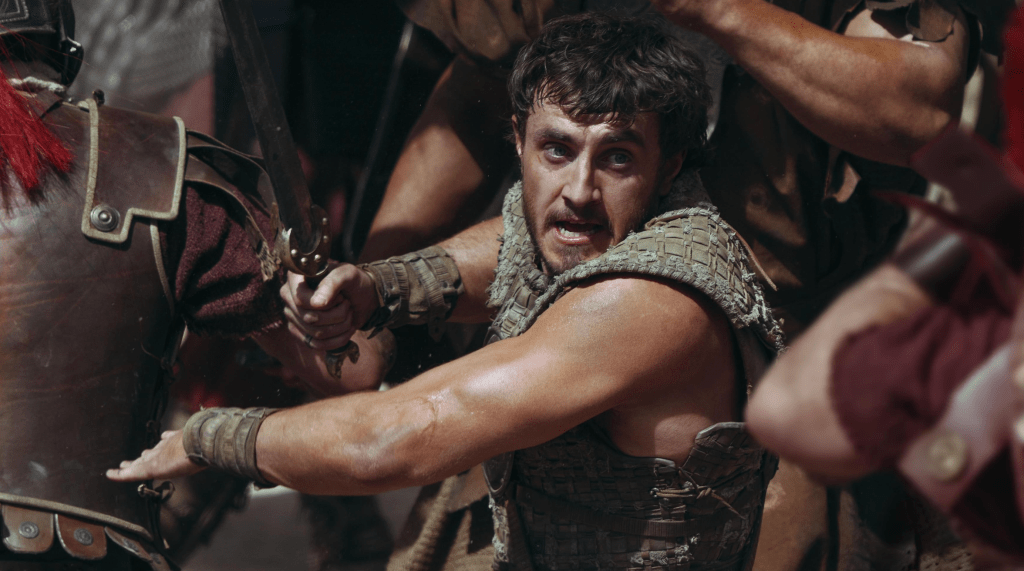
Speaking of Paul Mescal, he has the thankless task of playing a lead character who somehow feels like the least important player on the board. The son of Maximus and Lucilla (the film plays this like a half-time reveal even though the pre-release press openly stated it), he has lived his life in exile, marrying and settling down in Numidia. When Rome conquers his new homeland and kills his wife, it is the impetus for his revenge – already we are skewing too similar to set-up of Gladiator. As a gladiator, he spends the entire movie as a man without agency, and largely doesn’t seem to mind, content to be buffeted about by the whims of others until he can take his singular revenge on General Acacius (Pedro Pascal). Because of how little he actively progresses his own situation, Lucius feels like a blank, directionless character – is it plain old bad writing or is there a method to it? By the end you get a sense that, for better or worse, this was intentional – he is inevitably moulded into the second coming of his father, complete with his old armour and recycled catchphrases. He goes along with what other people expect of him because he is unable to imagine anything else for himself. The weight of two legacies bear down upon him – the emperor and the gladiator, the ruler and the warrior. All he wanted to be was a husband. But therein lies the rub – more time and development, especially before his capture, would only benefit the idea of this tragic loss of agency for Lucius, which remains merely fascinating in its current form. Mescal gives a strong performance, intense, physically engaged, charming in a way that Crowe’s Maximus never was, but the character’s lack of convictions make it difficult to connect with his struggles, and he is often sidelined by the many side characters and larger political plot. Blame the script, not Mescal – it’s thanks to his charisma that I had any interest at all in examining the character closer.
As the object of Lucius’ revenge, Acacius feels like an afterthought whose story screams missed potential. How did he come to be the preferred General of the mad emperors while disagreeing with their conquests? For that matter, how were the emperors even installed in the first place? Not a vital detail, but one that still makes its absence known. Where the script really misses a trick is in not having Lucius and Acacius meet even once before their final confrontation. No war of the words, no attempt at reason, no chance to flesh out their feelings towards each other. Pascal wastes a leading man performance on a character the film shows little interest in, beyond being an object of revenge for a hero with a similarly unexplored inner life. We get just enough of the mad twin emperors, played by Joseph Quinn and Fred Hechinger – they’re silly and entertaining without becoming overbearing, with hints of depth in their dynamic that invites speculation. Quinn pops as the more intelligent brother, a despicable hedonist who displays just enough frightening intelligence to explain how he’s held onto power, his performance giving shades of Malcom McDowell’s turn as Caligula. Hechinger is more straightforwardly goofy as the stereotypical mad emperor, yet fades into the background a little despite being more outwardly absurd. Neither is a match for Joaquin Phoenix’s deranged turn as Commodus, but neither has to be, because they are not the true villains of this story in the way that Commodus was.
Much has been made of how Denzel Washington gives the best performance in the film, but it’s not as lopsided as you’d be led to believe by other reactions. The real secret to how much he stands out is that his character is the most layered and clearly defined in the film, revealing new aspects of himself as events progress and keeping the audience on teh back foot whenever he makes his next move. Macrinus, the former slave turned Master of Gladiators, is playing political games on a level no-one else in the film can comprehend, driven by motivations that he only touches on. Every other character behaves exactly as expected at all times, slaves to their principles – Denzel’s principles are a mystery to the last, and so no action he takes could be called predictable. As in the first film, everyone looks to Marcus Aurelius’ “Dream of Rome” as a guiding light in dark times. But Macrinus says there is no Dream of Rome, that whoever believes in it has to die so a new dream can be born, that unfounded optimism is only another form of prison. And it’s hard to argue with him – even in the original film, the mechanics of this idealism buckled under scrutiny. Maximus died for this dream, the bittersweet triumph at the end of his story – now we see that his actions and his words changed nothing, that Rome continued to crumble despite the instructions he left behind. Macrinus is even right about the venerated Marcus Aurelius, a hypocrite who kept slaves and expanded the empire while speaking of peace and democracy for all. His famous Meditations, for all their philosophical value, are at odds with the way he lived his life and the legacy he left behind. Is it on purpose that the film fails to convince us that Macrinus deserves to lose? No valid reason is given to keep the Dream of Rome alive, no indication to be found that it is even possible. Does Lucius even believe in the dream, or is he trapped by a legacy he initially rejects, unable to become his own man? Denzel’s final emotion as he falls is a profound disappointment – all his hard work undone by a blunt instrument, he leaves Rome in the hands of those who cannot dream anything new (Ridley’s own view on the future of cinema?).
The second-to-last scene is a stiff, unconvincing triumph, hollow words and noise – Lucius waffles about rebuilding the Dream, but I couldn’t for the life of me remember a single coherent point he makes. The swathes of cheering soldiers and rousing music are meant to be enough to convince us that everything will be OK. It’s the film’s final scene that rings more true, as Lucius walks alone under an ethereal purple sky in the place where he watched both his parents die – a lonely orphan realising that he doesn’t know what happens next, and praying for the strength to find out. This is the scene that makes me believe Lucius’ lack of agency is a feature, not a flaw, though the execution leaves something to be desired still. How can this boy be the future when the past still weighs so heavily upon the hearts of everyone around him? When he himself is expected to redeem a failed legacy he has no choice in? The final shot being the iconic walk through the wheat field is a punctuation mark on the film’s relationship with the past, a film that embraced the legacy it was born into and in doing so has surrendered any chance of being seen as something new or distinct. This reading goes some way to explaining the muddled script, though not, in my opinion, excusing it. Gladiator II is as good of a legacy sequel as you could possibly hope for – if only it could have been something better. 8/10.

 Oscar Talks Movies
Leave a reply to November 25th – Last Week in Movies – Oscar Talks Movies Cancel reply