by Oscar O’Sullivan
In the age of complete cultural penetration for superhero properties, where audiences are familiar with and eager for more of the most bizarre corners of these comic-book universes, one question seems to gnaw at the Distinguished Competition – how can we sell Superman? Nearly a hundred years on from his inception, how can a story about the original costumed crimefighter dazzle a viewing public that is intimately familiar all of his increasingly complex descendants? The answer, as it turns out, is remarkably simple – take Superman himself back to basics and make everything else around him stranger than any superhero movie has ever been.
James Gunn’s Superman is the inaugural cinematic entry in the new DCU, a venture that Gunn himself is the head honcho of. Rather than taking his marching orders from a producer who wants him to fit into a broader story and universe, Gunn has free reign to create the exact tone and context he desires, using this standalone story to establish a surprising amount of continuity and interconnectivity right out the gate. Inevitably, I must compare this film to previous Superman adaptations, most specifically the seminal 1978 movie and Zack Snyder’s controversial Man of Steel. Both of those films chose to introduce Superman as the first godlike hero in a world that, up until his appearance, is exactly like ours in almost every way. Gunn very explicitly goes in the complete opposite direction, with an opening text crawl letting us know that the DC Universe has been home to ‘Gods and Monsters’ for a cool three centuries, and the story also bypasses Superman’s origins and early career, picking up three years after he first put his underwear on the outside of his pants. There’s something refreshing about the way Gunn handles exposition here, a lighthearted ease of delivery that prevents things from becoming overwhelming. A brief (and likely incomplete) list of concepts introduced as almost throwaway parts of the story – intelligent robots, nano-machines, cloning, pocket dimensions, aliens, Green Lanterns, fire-breathing Kaiju, element men, monkey-powered bot farms, flying saucers, quantum rivers, dimensional imps and a Hawk(girl) too. It reads as an intimidating collection of ideas for one story to try and tackle, but thankfully, a basic level of understanding on the part of the audience is implied. If you’ve experienced any sort of sci-fi media before, you’ll know what most of these concepts are without having to hear a long-winded explanation. Meanwhile, unexplained nuggets of lore are happily brushed past because they don’t have any bearing on the story at hand. It’s an experience akin to picking up a random issue of a superhero comic – there may well be characters and pieces of background info you don’t have a clue about, but if the story itself still entertains, you may well be tempted to find out more about these intriguing bits of set dressing. I’m sure that’s exactly what Gunn and co are banking on, judging by the speed at which they’ve begun discussing a spin-off for Edi Gathegi’s Mr. Terrific when audiences responded well to his supporting role in the story. No mention is made of his origin or motivation, he simply appears, speaks with Superman in a way that indicates they already know each other, and proceeds to play an important role in the story. Simple, clear storytelling remains priority number one.
Said story sees the Man of Steel landing in hot water after intervening in an international conflict, preventing a militaristic state from violently invading their poorer neighbour. Strangely, this inciting incident has taken place offscreen before the film begins, with the audience being quickly caught up to speed through some exposition dumps disguised as conversations. You’d have to be blind, deaf and dumb not to clock the similarities to the Russia/Ukraine and Israel/Palestine conflicts, though Gunn has done his best to deny any real world influence. Also plain as the nose on your face is the way Lex Luthor’s cultish tech empire is discussed in similar language to Elon Musk and his fantasies of building a techno-utopia. It’s not as overt as having Nicholas Hoult do a South African accent and ramble about colonising Mars, but the inspiration is there to be noticed. Nothing the film says or does with these broad allegories is deliberate, provocative or even insightful, but at least there’s undeniably a political angle to be found. Compare this year’s Captain America: Brave New World, where an African-American symbol of the world’s most powerful military battles a shady conspiracy bent on creating global instability before exchanging blows with a monstrous rage-fuelled President on the White House lawn – and you’d be hard pressed to come up with so much as a whiff of a political thought in any aspect of the film. If it seems lame to be crediting the bare minimum, we must remember that the bare minimum is still more than studios believe most audiences can handle.
David Corenswet is intensely likeable as Superman, playing it much more Reeves than Cavill. At the same time, he never becomes a joke or a punchline. When he is lighthearted and bantering, it’s an active choice for the character. When the situation goes south and lives are at stake, he firms up, squares his jaw and gives the impression of seriously focusing on the task at hand. There is also the affected performance of clumsy goofball Clark Kent, a distinct persona from the vulnerable, often tired and overwhelmed real Clark who we see in private with Lois Lane (Rachel Brosnahan) or at home on (almost comically quaint and idyllic) Kent farm. All of these modes are equally true to the core of the character, but the film raises central questions about identity and choice, making the differences in his behaviour important to observe. Superman, Clark Kent, Kal-El, whatever you want to call him – he struggles to define who he is both in public and private life. As Superman, does he represent America, his home planet, or merely himself? What gives him the right to take sides when his abilities are so superlative that he is directly described as ‘the most powerful metahuman’? All his life, he believed his Kryptonian parents gave him his mission to protect the weak in their holographic message. The mid-plot revelation that the recording also included the little wrinkle of subjugating the human race and breeding a new dynasty of Kryptonian overlords not only throws him into turmoil, it also shakes the world’s faith in the seemingly perfect hero.
Here is the other major ‘meta’ angle of the script, the examination of what Superman is really meant to stand for and how we, as mere humans, could ever trust or relate to him. As an immigrant allegory, it’s far from perfect – Superman must fully assimilate with his new home and reject the backwards ways of his native people – but taken as a purely fictional superhero narrative, it’s right on the money. An especially welcome aspect of the film is how it actively grounds itself in the present day rather than retreating into nostalgic artifice. The only real overt piece of pandering is the use of John William’s theme music from the 1978 original, and even that has been re-mixed into something a little more sleek and flashy, without losing any of it’s timeless impact. James Gunn’s new DCU is a far more fantastical place than our own humdrum world, but it is a place with a clearly defined cultural context and equivalent social issues to our modern day. Very little reference is made to recognisable real-world pop culture objects, allowing us to infer that the existence of metahumans has caused world history to tangibly diverge. Setting the exact date for the emergence of “Gods and Monsters” at 300 years ago creates some wiggle room for what has and has not changed from the history we know – for example, what real-world nations have Boravia and Jarhanpur replaced on the map? Was there a Cold War? A Dot-Com Bubble? Did the Twin Towers still fall in world of powered protectors? Questions like these may seem rudimentary, but they are the foundation of good world-building. Compare this with the MCU, where history and pop culture are an exact replica of our world despite the existence of magic, aliens and all the rest. Even world-changing, society-shattering happenings like an alien invasion of New York or half of all mankind being erased for five years are spoken about in-universe as if they happened on TV.
On the other hand, the insistence on avoiding real-world reference points makes it more noticeable when they do come into play. Maybe this was a factor in Gunn’s decision not to put together one of his signature pop-rock soundtracks, but he seemingly couldn’t help himself from including one little needle-drop, setting Mister Terrific’s big solo fight to the incongruously upbeat ‘Bring Me Sunshine’. While the fight itself is, ahem, terrific, kinetic and punchy, the song sticks out like a sore thumb in an otherwise score-based soundtrack. The only other piece of pop music in the film, ‘Punkrocker’, feels far less out of place as it plays over the final scene, acting as a sort of final release of tension and serving as a fun callback to an earlier conversation between Superman and Lois. Gunn’s ever-developing visual sensibilities also prove perfectly suited to the material. It’s far from the traditional cinematic ideals of beauty, in fact I wouldn’t entirely disagree with someone calling it ugly, yet it’s undeniably unique. When The Flash skidded into cinemas, I could see that there was something worth pursuing underneath the layers and layers of hideous, rushed effects concealing the interesting choices with lenses and camera movement. James Gunn seems to have had the same thought, re-teaming with Flash and Guardians cinematographer Henry Braham to create a sleek, energetically shot work. The completely free-roaming camera and cuts to extreme angles call to mind the flow of comic-book panelling whole also being a uniquely cinematic way to structure action. I am a firm believer in the following tenet – cgi-heavy action films should throw caution to the wind and create spectacles impossible in real life rather than shame-facedly attempting to create ‘realistic’ set-pieces. One standout sequence has Superman battling baddies in an interdimensional river of brightly coloured cubes while protecting a freakish green cgi baby from harm. To attempt to make that look realistic would be an insult to my intelligence, so thank Zod this film embraces the inherently fantastical nature of this genre and really goes for broke.
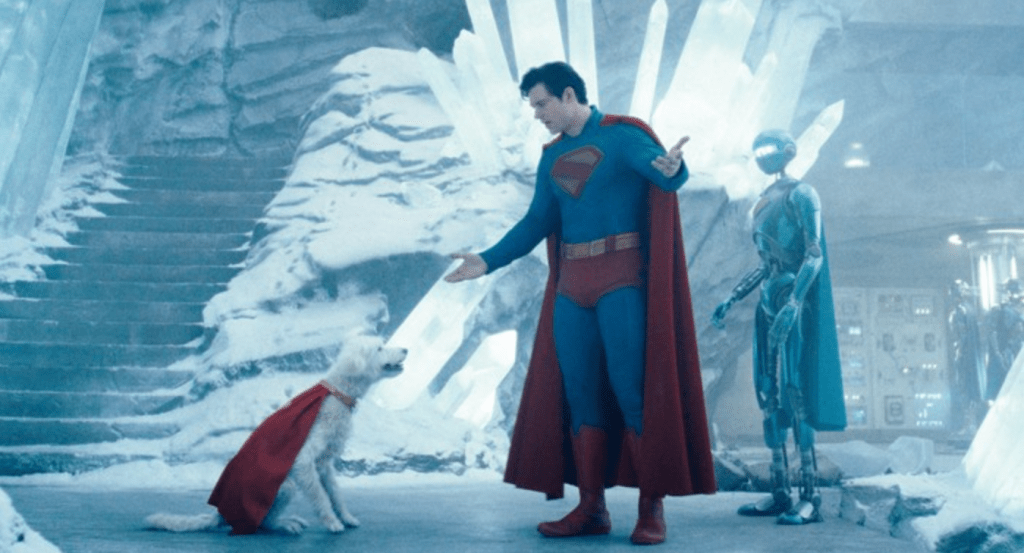
There are certainly some flaws I could go into; for example, the human supporting cast, specifically the Daily Planet crew, could have been used to greater effect. Everyone is briefly introduced in a scene early on, then largely disappear until the final act where they are brought in to play a comical role in the ultimate conclusion. Only Lois Lane and Jimmy Olsen get to play any real part in proceedings. Rachel Brosnahan is quite good as the no-nonsense reporter, though she could have been more of a sarcastic hardass. A clear effort was made to give her a role in the plot beyond being Superman’s love interest, but their romance remains key to the emotional core of the film. Skyler Gisondo is delightful as Jimmy Olsen, a sort of oblivious playboy who reacts with muted beffudlement as every woman in the movie throws herself at him. And then there’s the films main non-human cast member, Krypto the Superdog, a yappy little mongrel that innocently causes chaos and destruction wherever he goes. Gunn is obviously well-used to shooting convincing cgi animals, and Krypto’s inclusion, despite still feeling a little silly and contrived, proves to be an essential factor in setting this apart from other adaptations. His pivotal role in the action climax completely justifies the choice to use him, making it clear that Gunn didn’t simply add so silly a concept as a super-powered dog sidekick just for the sake of being strange or quirky. Sure, it still is strange, but it’s strange with a purpose – rather than ‘how many strange elements will this film support’, it’s ‘how much film can I craft with these strange elements’.
Even with all the above said, I am ending this review with topics left untouched. For one, Nicholas Hoult’s Lex Luthor is such a dominating villainous presence that I’d almost dedicate an entire review just to framing the film around him. So let’s just call this a pause, a little break before I come back with fresh eyes and some new angles of attack. Because I do believe this is a superhero movie that will be talked about for a long time to come, certainly one that will have more staying power than any of Marvel’s 2025 releases. I’ll end on this note – the film was announced under the title of Superman: Legacy, a title that suggests nostalgia, regression, in short, every backwards pandering trend that is killing the superhero genre. Dropping that subtitle was a statement; this is not just another Superman movie, a rehash, a museum piece, whatever. This is, straight up and with no pretences, Superman – what more is there to say than that? 9/10.
 Oscar Talks Movies
Leave a comment