by Oscar O’Sullivan
Mission: Impossible – The Final Reckoning has so much going on that it feels daunting to figure out where to start, as even the beginning if the film is like a headlong dive into the deep end of a pool that’s on fire. Once we decide where to begin, we face the challenge of figuring out what exactly is going on with this messy, ambitious action epic, at once a farewell to Tom Cruise’s most profitable creation and a statement of intent for how he aims to continue dominating the industry in the face of technological uncertainty. If this already sounds like a bit much to be dealing with, keep in mind that the actual plot is also an overstuffed, bafflingly structured adventure of competing motivations and constant goalpost-shifting. At once completely self-serious and knowingly cartoonish, it may not be the best Mission: Impossible film, but it does make sense as a finale to franchise that could never fully settle on one identity.
With eight films over almost thirty years, the M:I franchise is inextricably linked to the career ups-and-downs of it’s star, Thomas Cruise Mapother IV. The original film, released in 1996, was a vehicle for Cruise at the height of his stardom. With over a decade of hits under his belt, Cruise had worked in a variety of genres with many of the greatest American directors. When you look at the other films he made in the 90s, both before and after this, you’ll realise that “Tom Cruise: Action Star” wasn’t really a thing at all – he was, first and foremost, a dramatic actor. Fast-forward to the 2000s, and changes become apparent – action blockbusters begin to increasingly dominate his filmography, with the second and third M:I films being much more about high-octane violence that the twistier, espionage focused original. At the same time, Cruise’s personal life is tanking his off-camera reputation, with marital woes and vocal involvement in Scientology creating an inhuman public perception that persists in some form to this day. By 2011, things are so bad that Paramount actively attempts to write him out of his flagship franchise, penning a script for Ghost Protocol where Cruise’s Ethan Hunt character is killed off, passing to torch to the then-hot star Jeremy Renner. This turning point in Cruise’s career sets the tone for everything that followed, forcing him to reassess his priorities and take a firmer hand in how he’s presented, both on-and-off-camera. Thanks to writer Christopher McQuarrie shaking up the script before Hunt can be killed off, Cruise not only keeps his grip on his biggest franchise, but takes it to new heights, building a mythos around the increasingly dangerous stuntwork involved. The 2010s are when the image of “Tom Cruise: Action Star” becomes firmly entrenched in the culture, as he drops basically every other genre in his repertoire. Gone is the Cruise who sought out interesting directors to challenge him – now he exclusively works with safe, dependable yes-men who he knows will do things the way he wants them done. This is most apparent in his continuing Mission: Impossible sequels, with films five and six both being helmed by McQuarrie. Slowly but surely, Cruise’s image undergoes a rehab – yes, people still see him as a weirdly intense Scientologist who probably knows where the bodies are buried, but he also becomes synonymous with satisfying action, and as the MCU-ification of cinema ramps up, Cruise becomes more and more notable for being one of the few stars who can headline a film based on his own name, rather than franchise recognition. Sure, his first three films of the 2020s are all sequels, but they are sequels to hits that he originated. For better and for worse, Cruise is bigger than the characters he plays. And now, with The Final Reckoning, he aims to say farewell to the character who has travelled with him longest – but is Ethan Hunt a character at all anymore, or just an avatar for Cruise’s reckoning with his own place in the industry? Because we may be saying goodbye to this particular franchise, but there doesn’t seem to be any end in sight for Cruise’s death-defying brand of action cinema.
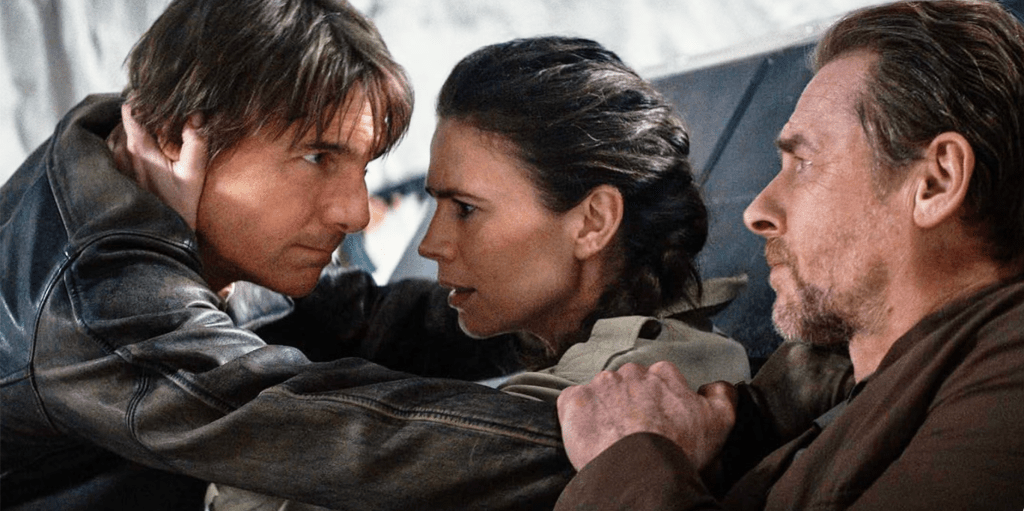
While the Mission: Impossible films may have started out as essentially an anthology series, the McQuarrie era has seen more focus on continuity and legacy, which comes to a head in the disorienting opening hour of this film. On a literal level, the film takes pains to remind you of the journey taken to get here, rife with silent flashbacks to previous films as it loosely ties all of their plots together. It seems to have been written under the assumption that the audience has either forgotten or never seen any prior M:I film, including the one that this is a direct sequel to, so every callback is both completely unnecessary but also heavily focused on. On a secondary but no less unsubtle level, there is the symbolic representation of Cruise’s place in the industry. The film opens with Hunt in hiding after going rogue (read: refusing to follow studio mandates) as he searches for a way to destroy the Entity, an Artificial Intelligence bent on wiping out mankind (destroying cinema). He’s implored to turn himself in by Angela Basset, President of the United States (or perhaps the head of Paramount Pictures), who insists that destroying the Entity is a bad idea and that he needs to help the Government take control of it instead (make A.I. generated content). Every character Hunt encounters along the way is incredulous over the details of his plan and the resources he demands (i.e. the potentially lethal stuntwork and ballooning budget of the film), while his supporting cast of IMF teammates trust him unconditionally to get the job done. Said crew (Simon Pegg, Hayley Atwell, Pom Klementieff and Greg Tarzan Davies) spend about half the runtime off on their own separate mission to get Hunt where he needs to be, which is unfortunate – the best character writing in these movies is when Hunt gets to really bond with his team – but the whole gang gets back together in time for the climax, until Hunt once again has to dash off on his own to chase down a propeller plane and dangle perilously over the landscape without a parachute while the rest of the gang does the real spy work of hacking a secure bunker and defusing a nuclear bomb. As I write this, I wonder whether the amount of time spent without Ethan Hunt was a way of testing the waters for a Cruise-less future M:I instalment. The supporting cast do all have great chemistry with each other, but I don’t see a real demand for this format without a single charismatic anchor for the whole thing to revolve around.
Speaking of the future, this purported finale doesn’t close the book by any means. It feels like Logan and Infinity War set the standard for what a “grand finale/farewell to an actor’s iconic role” story should be, and Final Reckoning is the third major example of this archetype to release in the 2020s, following No Time to Die and John Wick 4. There are two big expectations that come with this type of film – first, that it should be either a celebratory wrap-up or somber deconstruction of it’s own franchise. Final Reckoning certainly fits the former category, with it’s barrage of callbacks and homages to past adventures, but it also doesn’t feel like a closing of the book because Mission: Impossible never really had a myth arc or ongoing storyline waiting in the background to be wrapped up. Though an effort is made to present this as the culmination of the seven previous outings, it winds up being just another episodic adventure, with only one major supporting character bidding a definite farewell. That brings me to the second expectation – that the hero must die. After all, how can it be a finale if they live? A happily ever after doesn’t cut it, especially in the world of ongoing franchises – if a character is last seen alive, there will be a constant expectation that they could return at any moment. Just look at the three big deaths from Infinity War as an example – Iron Man and Black Widow are conclusively put to rest (multiverse shenanigans and prequels aside), but because Captain America is last seen alive as an old man, rumours constantly abound that he could reappear in a future project. But, despite the inferred finality of this film, despite the longstanding assumption that Ethan Hunt’s luck would have to run out eventually, the hero does not die. The world is safe and Hunt walks away unscathed, with the final scene implying another mission is already on the cards. It’s not a surprising choice – Hunt is a representation of Cruise as a movie star, so for Hunt to die, it would be an admission that there is a possible future (for cinema) without Cruise in it. James Bond dying was a shock but one that makes perfect sense – Craig wasn’t the first actor to play the role and likely won’t be the last, so giving him a fatal send-off to mark a franchise milestone made sense, especially since No Time to Die was the only Bond film produced with the explicit foreknowledge that it would be the star’s last go round. John Wick is a different case – Keanu Reeves originated the character, and there’s a strong sense that nobody else could or should play Wick. But Wick’s fate in the fourth film was abrupt in a way that felt almost intentionally misleading, and the confirmation of a fifth entry raises interesting questions of how premeditated this fake-out may have been. In both cases, audiences are well aware that the end isn’t really the end at all. To loop back around to the earlier comic book movie examples, both Robert Downey Jr and Hugh Jackman have triumphantly returned to the Marvel stable after saying very definitive goodbyes – now the only guarantee that a star won’t return is their real-life death, assuming studios don’t go all-out on digital AI resurrections. Funnily enough, Mission: Impossible films reportedly make sure they shoot the stunts in order from most to least dangerous, so that if Cruise does die spectacularly on set he’ll do it before they get too deep into production.
To find what finale/farewell Final Reckoning most closely resembles, we must actually cast our eye back to 1989’s Zatoichi: Darkness Is His Ally. Like Ethan Hunt, Zatoichi was a character originated and performed by one actor, Shintaro Katsu, in a long-running franchise. Darkness Is His Ally released over fifteen years after the previous final film and ten years after the conclusion of the hundred-episode TV series, choosing to celebrate the legacy of the series by being another standalone actioner rather than an epic finale, ending with Zatoichi wandering away as he does at the end of every adventure, off to face whatever comes next. While that franchise would continue with intermittent remakes and reboots, Katsu would never again play the character, ending his almost thirty years in the role on an open-ended note. This is exactly where The Final Reckoning leaves Ethan Hunt – victorious, more assured than ever of the necessity of his mission, smiling wryly as he surveys his team before vanishing into the crowd as the credits roll. The film’s torturously expository opening hour and quiet, uneventful ending minutes are the biggest obstacles to fully appreciating it, but everything in-between is the series doing what it’s always done best. Perhaps that’s as good a way as any to say goodbye, with a comfortably familiar ride over the finish line. Assuming, of course, that Cruise doesn’t change his mind and decide the world (and the film industry) really can’t survive without Ethan Hunt and the Church of Scien- I mean the Impossible Mission Force. 8/10.
 Oscar Talks Movies
Leave a comment