by Oscar O’Sullivan
I am a fan of Marvel. I feel like I have to make this clear whenever I touch a comic-book film because, by and large, the way I talk about Marvel movies nowadays would have you believe I am the greatest and most fervent enemy of the House of Ideas. But I love Marvel, and I used to love the MCU. I’ll never forget being a stupid eleven-year-old hanging out in the Omniplex entranceway, seeing the trailer for the original Avengers movie where Thor, Iron Man and Captain America fight in the woods and thinking “this is really happening”. Over a decade later, my tastes and standards have changed, but my enduring love of superheroes remains, despite the absolute beating it’s taken in the post-Endgame era. It hasn’t been all bad, sure, but the fleeting flashes of excellence (Guardians Vol. 3, Doctor Strange 2) felt like complete flukes, struggling against a tide of increasing mediocrity that gave way to outright awfulness in the last two years. Mere months ago, I rolled my eyes as Captain America: Brave New World landed in cinemas with a resounding thud (editors note: read my review for that film here, True Believers!). And now, with the taste of that last failure barely washed out of my mouth, we have a film that seems to commit every sin in the Modern Marvel playbook – a film crammed with characters from previous projects, some of whom haven’t been seen or mentioned in six years, with an untested Indie darling director, practically no resemblance to the comic it’s based on and a marketing campaign that veered wildly between ‘intriguing’ and ‘abjectly embarrassing’. Here, surely, is the final humiliation, the culmination of four years of floundering, Marvel’s final failed attempt to course-correct before the inevitable reboot after the next big crossover. How could Thunderbolts*, a film so self-conscious its official title comes with a built-in footnote, possibly be anything other than another modern Marvel misfire? How, indeed. That’s the question I’ve had to ask myself as I write something I’ve long hoped to be able to – a positive review of a new MCU film.
When it was announced back in 2022, Thunderbolts* seemed a less than promising prospect. Strangely similar in concept to DC’s recent Suicide Squad films, headlined by minor characters largely introduced in some of the less popular MCU entries, the initial reveal drew a fairly muted reaction. A series of rolling delays due to Marvel’s general creative overhaul and the 2023 Writers’ Strike didn’t bode well either, but by all accounts this was a smooth production, to the point that they proudly shared behind-the-scenes footage in marketing materials to show off how much was done practically. Said marketing was also cause for concern when interviews with cast and crew had a lot of big talk about how they approached the production with an “indie ethos”, culminating in a trailer that explicitly brags about the amount of A24 talent involved. Given the studios’ history of having creatives talk out of their ass about the potential of their films (for example, the stinking turd that is Ant Man 3 being likened to the work of avant-garde director Alejandro Jodorowsky), the film had surely set itself up to fail. Thunderbolts* seemed destined to flop in the same manner as Eternals – creating artistic expectations it couldn’t possibly achieve and consequently being criticised even more harshly than it otherwise would have been. How startling it is then that Marvel has delivered on its promise – Thunderbolts*, in many ways, does not feel like an MCU movie. Or, if I may be so bold as to immediately contradict myself, it feels like an MCU movie should.
Now, it’s far from being some brilliant work of art. It’s competently shot, the action is rather safe and bloodless, the script is peppered with inconsistencies and moments where you can tell the writers pulled back from something that would really step over the line, something an actual arthouse film would rush headlong into with screaming abandon. However, hot on the heels of Captain America: Brave New World, basic competence feels like a revelation. I’m being overly harsh, of course, as competence isn’t really the right word. It’s simply amazing how solid the film is on a technical level. Shots are motivated and generally well-lit, the majority of scenes take place in real locations, the actors are able to properly bounce off each other, action is almost entirely practical, grounded and visibly legible, with believable choreography and moments of spectacle that feel earned. At long last – the bare minimum! Don’t get me wrong, I am genuinely pleased with this development – even if I wasn’t blown away by the visual artistry, it’s such a relief to not be rolling my eyes at wonky, slapped together images. Director Jake Schreier was clearly working off of a finished script and, bar a couple of insignificant pickup shots and the post-credits epilogue, there’s none of the jarringly out-of-place inserts that betray the troubled productions of many other modern superhero flicks. The film is even edited in a way that seems designed to show off how confident they were in what they shot, rarely cutting away during action scenes and lingering on the performances in dialogue scenes, especially when the cast share the frame – no obvious green-screen compositing in sight, at least not any that I spotted, which is the important thing. While we’re on the topic of me being impressed by basic competency, the score is a curious article, going for dainty melodies at times where bombastic blocks of mindless orchestral music would be expected and dipping into darker soundscapes that enhance the tone of the film’s spirited attempts at psychological drama. The same crew behind the music here also scored Everything Everywhere All at Once, another clear example of the film trying to Frankenstein together an “A24” vibe and coming surprisingly close to a convincing imitation.
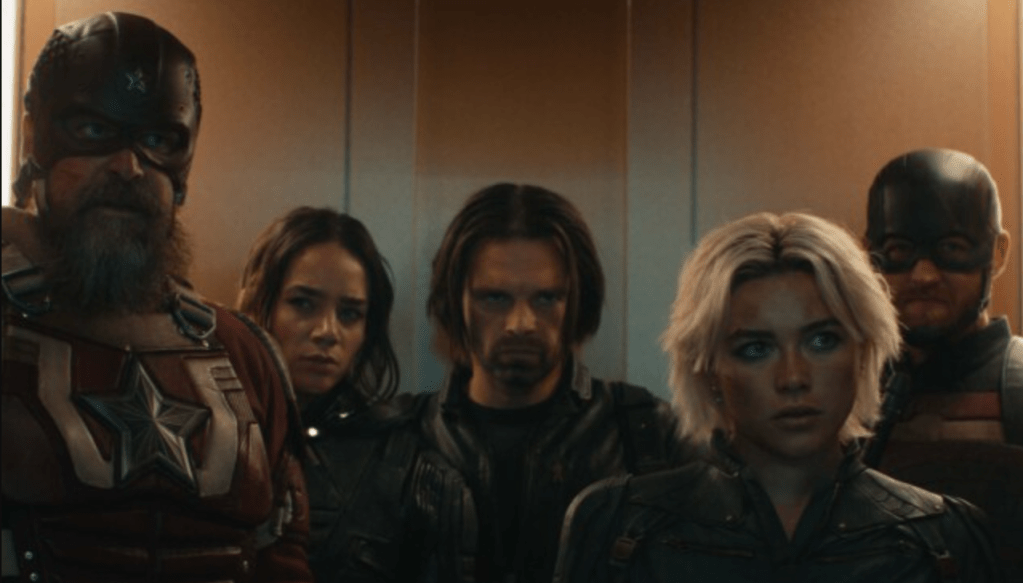
Right away, the plot casts off any concerns about being a rehash of DC’s similar team – rather than a squad of villains wrangled together for black bag operations, the Thunderbolts are introduced as solo operators who have been tricked into wiping each other out by shady string-puller Valentina Allegra De Fontaine (Julia Louis-Dreyfus). De Fontaine functions as a sort of evil Nick Fury, having cropped up in a couple of previous MCU entries as a vague governmental figure with nebulous plans. We learn that she’s been contracting out a number of villains and anti-heroes to do her dirty work – including new Black Widow Yelena Belova (Florence Pugh), disgraced Captain America replacement John Walker (Wyatt Russell), ethereal assassin Ghost (Hannah John-Kamen) and former Red Room asset Taskmaster (“Olga Kurylenko”). With a government commission closing in on her crooked super-soldier-experiment operations, De Fontaine uses these professional killers to clean up the evidence, including themselves. After an initial scuffle and some brief deductive work, the characters realise they’ve all been played, and form an uneasy alliance to save their own hides. They’re joined along the way by Bob (Lewis Pullman), an amnesiac prisoner they discover in the same deathtrap that’s been set for them, Yelena’s adoptive father Alexei “Red Guardian” Shostakov (David Harbour) and former Winter Soldier Bucky Barnes (Sebastian Stan), who has inexplicably become a U.S. Congressman but quickly steps back into the role of implacable super-soldier when legal channels prove useless. It’s a simple set-up that doesn’t rely on shocking swerves or complex planning to get the job done, with the one major twist being heavily telegraphed in advance. The film instead spends time that would have been wasted on exposition or elaborate plotting developing the characters, allowing them to establish rapport, build dynamics and let the audience really fall in love with them. Most importantly, it takes the time to properly introduce and establish each character, rather than expecting audiences to already be familiar with them. Sure, there are some details that you’ll only get if you watched the three or four movies and two TV shows that this directly follows up on, but it functions perfectly well as a self-contained object.
Perhaps I’m giving the script too much credit here, but I read a certain subtle mockery of the MCU’s recent direction in the way the characters were handled. To elaborate, these characters are all second-stringers who have remained largely off-screen since their debuts. The most recently-spotted was Bucky in a tiny cameo role in Cap 4, while Ghost hasn’t been so much as mentioned since her debut in 2019. What have these characters been up to in the time since we’ve seen them last? For the most part, killing people and being desperately lonely. None of the leads have a functional social life, any sort of family, any hobbies or interests outside of their black ops work. This is why I read the film as a subversion of modern superhero stories – these characters have increasingly been reduced to the action they take part in, their civilian casts stripped away as the stories become hyper-focused on world-ending stakes, military escapades and dimensional shunting. The majority of MCU heroes have no civilian identity, their names and codenames being used interchangeably, and it becomes more and more difficult to imagine what, if anything, they do when out of costume. Thunderbolts* plays almost as an indictment of that trend, taking it to a logical extreme – our “heroes” are badass murderers and emotionally dead inside, existing as nothing more than tools of violence and practically interchangeable when it comes to function. This idea of expendability actually goes some way to justifying the homogeneity of powers and skillsets in the cast, as well as allowing what actually sets them apart to shine – their individual personalities. They may all punch and shoot the same way, but they don’t think or feel the same way.
Since the film leans so heavily on the cast in so many ways, let’s dedicate some time to looking at each of the heroes. First and foremost is Yelena, the de facto protagonist. While it is a team movie, Yelena has the clearest arc and is the fulcrum around which the other characters all rotate. Introduced in Black Widow as Natasha’s younger, more immature sister, she also turned up in Hawkeye on Disney+, acting as a sympathetic antagonist out for misguided revenge. This film expands on her grief over Natasha’s death, showing that she has completely retreated into her work – she’s introduced assaulting a secret laboratory dressed a hoodie and sweatpants, delivering deadpan voiceover while blankly murdering guards and scientists. Later scenes all but outright state she’s developed a drinking problem and spends all her free time between missions getting absolutely blasted by herself. Despite her fragile mental state, she’s also the most affable and moral of the misfits. She quickly establishes rapport with the other characters through her dry banter, becoming the glue that holds them together when shit hits the fan. Of course, the pressure of being responsible for other people puts her under even more pressure, with outbursts of emotion that Florence Pugh is more than capable of pulling off. Her tears feel much more real and raw than the conservative register of emotion superheroes are normally allowed to display, making her even more endearingly vulnerable and human. The MCU has had a major turnover problem, failing to elevate supporting players or new stars to the levels of popularity and importance that the OG cast enjoyed. Strong writing and Florence Pugh’s own star power have made Yelena the first successful promotion of a “new gen” character to icon status.
Everyone else plays second-fiddle to varying degrees, though (almost) nobody is surplus to requirement. Bob is the film’s brand-new addition, a nervous but well-meaning amnesiac with vaguely defined and supremely dangerous powers. He’s instantly endearing as the hapless “ordinary” member of the group, and equally uncanny when he’s later unveiled as Sentry, a corporate focus-grouped ubermensch in a gaudy gold uniform. Designed by de Fontaine to be the “perfect hero”, she fails to reckon with the possible consequences of giving a mentally-ill meth addict a God complex, and so our ragtag band of antiheroes are pitted against the so-called ideal of superheroism. After Pugh, Pullman carries the most emotional weight in the story, no mean feat for a newly introduced character in a story populated by familiar faces. He takes a character who was largely an annoying gimmick in the source material and makes him one of the best new additions to these films in years.
And then there’s the rest. John Walker returns after his starring role in Falcon and the Winter Soldier, which ended with him brutally murdering a surrendering man in broad daylight and leaving the Captain America mantle in disgrace. Rebranded as the U.S.Agent, he remains outwardly cocky and arrogant, but his fall from grace clearly weighs heavily on him, and we learn his wife and son left him over his self-centred obsession with his past failures. Although the film has him taking a fair amount of verbal beatings from the other characters, he also proves to be a safe pair of hands in a crisis, and though his sadness and his personal situation are never directly resolved, there is a sense that the events of the film afford him a change of perspective for the better. Wyatt Russell gave a standout performance in the Disney+ series and repeats the feat here, straddling a fine line between being an entertaining annoyance and a genuine prick, while also being quite endearing when he slows down and drops his guard. Then there’s Alexei, who plays a pivotal role in Yelena’s emotional journey while also being mainly used for comic relief. David Harbour relishes in the buffoonery of the part, overacting to the fullest, but is still convincing in the emotional scenes. In many ways, it’s a repeat of Black Widow – both films have the same writer, Adam Pearson – where his chemistry with Pugh provided some of that film’s highlights, even if the character is never really held as accountable as he should be for his complicity in her childhood trauma. When the final act kicks off and New York is (once again) under attack, it’s Red Guardian who is first to leap into action and begin saving civilians, with the rest following suit. Alexei, of all the characters, most desires to be useful and to be seen as a hero, and of all the characters, he surprisingly has the healthiest idea of what a hero actually is – not a fighter or a killer, but a protector, a saviour. The finale is so refreshing precisely because it focuses on that oft-overlooked aspect of the genre, first through the straightforward saving of civilians from crumbling architecture, then in the more cerebral final battle, where punching the problem only makes things worse and, sappy as it sounds, empathy saves the day.
Then we have the leftovers of the team. Ghost, the intangible assassin, was last seen in Ant-Man and the Wasp, where she abandoned her desire for vengeance and slunk away to find a cure for her powers. No mention is made here of a desire to cure herself, nor is any explanation given for the location of her mentor and father figure Bill Foster. It feels as if Ghost has been dropped into this film from out of the blue, her origin barely mentioned in passing and no deeper motivation so much as sniffed at – she may as well be a brand-new character. She would feel entirely extraneous if not for her decent chemistry with the rest of the crew, the visual variety her powers bring to the table, and Hannah John-Kamen’s performance, which is more snarky and jaded than her previous attempt at sinister intensity. Going behind-the-scenes a little, this character was included only because the actress mentioned she would like to be in a hypothetical Thunderbolts movie some years ago, and because the writer decided he’d like to write for her. When no natural-feeling reason could be found to integrate her or her backstory, they seem to have simply pressed on and plopped her in anyway, a decision I almost admire for its stubborn determination. Then there’s Bucky, who accidentally becomes a sort of custodian for the team. His role as a Congressman never stops feeling silly, especially since Sebastian Stan is so visibly bored with the material. He gives easily the most checked-out performance, though it’s hard to blame him – he’s one of the only actors to have appeared in every single phase of the MCU, and with Bucky’s arc essentially complete after the Disney+ show, he’s become a static character, wheeled out to support the new blood but with no real material to chew on himself. He contributes one Terminator-inspired action scene and a certain air of legitimacy as the biggest established star on board, but is otherwise a seat-filler who could easily have been cut with another pass on the script.
And last but not least, there’s Taskmaster, the villain of Black Widow, who was spared at the end of her battle with Natasha and given a second chance at life after being nothing but a weapon for her whole life. A character who makes perfect sense to include in a story about redemption and becoming more than what you thought you could be, Taskmaster naturally has a single line of dialogue and roughly the same amount of screentime before being shot in the head by Ghost. Before the characters have even learned each other’s names, let alone become a team, she is unceremoniously killed and basically goes unmourned. It’s not like she was a particularly beloved or interesting character, but it’s the one piece of writing in the film that feels like a genuine misfire, a misguided attempt to emulate the “anyone-can-die” excitement of a Suicide Squad adventure that falls completely flat. It is, however, sort of funny. For one, the almost comical abruptness of her execution and immediate brushing over of her whole existence is like something out of a Deadpool film, and then there’s the fact that the other “heroes” immediately start pilfering her corpse for gear. It really is kind of mind-boggling that one of our eventual heroes, a character we obviously want to root for as redeemable, shoots another potential protagonist in the face and doesn’t really dwell on it at all. Olga Kurylenko enjoys ludicrously high billing and a spot on every poster for having her face briefly superimposed over a stunt double as she delivers her single line. Magnificent.
So what is the ultimate point of The New Avengers? Yes, that’s right, I’ve switched to calling it by a different title right at the end of the review because that’s exactly what Marvel themselves have done. They couldn’t even wait a full weekend before pivoting the marketing to be all about the big ending reveal – very sorry if you didn’t see it on opening night! Before watching the movie, I would have said this was a stupid, mercenary move – a desperate gamble to improvise a new team with whatever actors were at hand right before next year’s big crossover. But, and I’m as surprised as you are, I think this team truly earns the right to be called Avengers. Not because they’re badass, not because it’s subversive to have an Avengers team of black-ops killers and hardened psychopaths, not even especially because they’re ultimately likeable characters. It’s because the film is constantly building towards that transformation, that earning of the right to call themselves heroes. It shouldn’t be this refreshing to see heroes saving civilians as the centrepiece of a story, but it is, it really is. But is it too little, too late? The New Avengers finally answers questions that have been looming over the MCU for the last two Phases – questions about where this thing goes now that the original story is tied up, whether or not new characters can live up to the classics. This is exactly the movie the MCU needed – three years ago. It’s hard not to feel like this should have been the capper to Phase 4, especially since every thread it picks up had already been established by the end of 2022. After five years of floundering with indecisive direction, aborted storylines, behind-the-scenes chaos, bloated television spin-offs and every new entry feeling like an increasingly disconnected dead-end of storytelling, The New Avengers recaptures that early Marvel magic. It follows up on what came before in an understandable way, genuinely changes the status quo of this shared setting, creates exciting opportunities for future stories and, most importantly, tells an entertaining and impactful story of it’s own. That makes it sting all the more that we likely won’t get any sort of time with this new team, as the MCU is one entry away from the next bloated mega-crossover that could well wind up pushing the reset button entirely on the whole project. A somewhat infuriating reminder of how good these movies can be, how good they could have been over the last few years if they’d kept their eye on the ball. I’ve missed this. 8/10. If Fantastic Four isn’t at least this good I’m really going to do it this time.
 Oscar Talks Movies
Leave a comment