by Oscar O’Sullivan
Monday – Octopussy
Let us consider, if you will, a climactic action scene from the film Octopussy. Roger Moore’s Agent 007, having tumbled from a train while chasing down the villains, has rushed across Germany by hitchhiking and stealing cars. Upon finally reaching the military base that is soon to be obliterated by a nuclear bomb, he is forced to trespass and is chased down by a cavalcade of guards. He has one option to blend in – thinking quickly, he dons a full clown getup and rushes into the circus tent where the nuclear device has been concealed in plain sight. Cue a series of comic misunderstandings where the cackling audience assumes that everything the frantic clown does is a part of the show, even when he begins to desperately yell to the American general that a bomb is about send the whole place sky high. This could be a very fun sequence – if i was watching a Naked Gun film, that is. It’s not that I’m opposed to seeing heroes struggle, but Bond being made to look ridiculous simply feels wrong. And it’s not just that the film keeps putting Bond in silly, undignified situations – Moore looks fundamentally uncomfortable, a combination of age and embarrassment damaging the necessary facade of coolness so vital to making the character entertaining. Connery also played the role for about ten years, but he didn’t feel any less believable at the end than he did at the start. Only two years prior to this Moore was perfectly convincing in the straightforward action thriller For Your Eyes Only. Without the unflappable invincibility of Bond as a grounding presence, the whole endeavour begins to fall apart, because despite the constant forays into the comical, the film is not a parody, and does not successfully operate as one. Especially irritating is that the film has a conventional, promising setup for Cold War spy drama. There was no reason to lean so whole-heartedly into the zany circus antics and dubious Indian representation when this premise could have made for the most seriously grounded entry since From Russia With Love. Instead, this is the first Bond film that I’ve actually disliked. At least it’s hard to imagine it getting any worse than this. 4/10.
Tuesday – Witness for the Prosecution
Billy Wilder’s Witness for the Prosecution is an absolute belter of a legal drama, where an open-and-shut murder case careens off in wildly unexpected directions and bamboozles our attention without ever showing us anything beyond the walls of the courtroom and the barrister’s offices. The satisfying excellence of the mystery is to be expected from an Agatha Christie story, elevated by Wilder’s superbly measured direction and the trio of captivating lead performances. Tyrone Power may be top-billed as the accused murderer, and Marlene Dietrich may be the titular character, but it’s clear from the word go that Charles Laughton is the star of the show as crusty barrister Sir Wilfred. Our introduction to the film is through Wilfred, returning from a stint in hospital with a fussy live-in nurse (Elsa Lanchester) and strict instructions to avoid any sort of strenuous work. Wilfred is not a man to meekly follow orders, of course, so it’s not long before he takes on a high-profile murder case, where he has to pop pills like candy and swig from secret reserves of brandy to keep himself upright. Wilfred may seem at first to be an arrogant and vainglorious figure – he is staggeringly rude to his nurse and gleeful in his efforts to confound her care, as well as cold and adversarial in his early interviewing of the accused and his wife. This makes the story seem at first to be a sort of cautionary tale, a brilliant man working himself to an early grave out of pride. But as the trial gets underway, not only do we quickly learn that Wilfred really is that good of a lawyer, his stubborn refusal to back away is also recontextualised as an act of sacrifice – he believes in his client’s innocence fully and knows that he is the only lawyer with the talent and commitment to save him from execution. To discuss the film any further would risk spoiling the delightful and shocking swerves the plot takes – swerves the film is so proud of that the end credits feature a voice-over imploring the audience not to divulge plot details to their friends. See it for yourself, on Amazon Prime right now. 10/10.
Wednesday – The Colossus of Rhodes
A decent film I have very little to say about. There’s simply no substance here, no standout formal qualities or interesting themes. It follows the most basic general swords-and-sandals plotline, that of an elitist conspiracy being overthrown by an uprising from the lower classes, led by a sympathetic nobleman with a strong sword arm. The one real point of interest here is centring the story around the Colossus of Rhodes, the lost wonder of the ancient world. The statue is imagined as being a secret weapon, filled with traps and devices that can rain fire down on unwary attackers. The most inspired action sequences are the ones that take place in and around the enormous statue, including a fun duel that takes place on the arms of the Colossus hundreds of metres above the ground. A visually appealing film with grandiose costuming and set design but nothing that could really be referred to as unique style. I wouldn’t have looked twice at this if it weren’t the directing debut of Sergio Leone, a classic case of a director taking a passionless money job to get their foot in the door and practice the fundamentals of the craft before developing an actual vision in later efforts. 6/10.
Friday – The Alamo and The Hustler
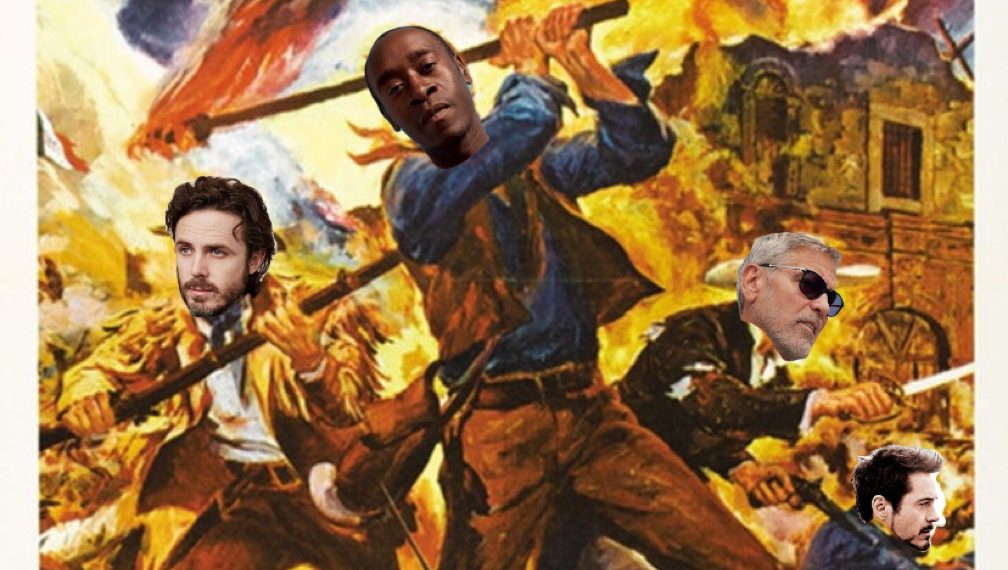
To be three hours long is not a crime, but to be three hours long with a script that could be generously described as ‘utterly formless’ should at least count as a misdemeanour. Star and first-time director John Wayne clearly didn’t have the discipline hammer this rambling epic into shape, but as rambles go, at least it isn’t boring. Only the film’s final scene depicts the actual last stand at the Alamo, with the rest of the gargantuan runtime being devoted to a long winded and comprehensive backstory of the various defenders and their interpersonal struggles. Most of the friction is between the by-the-book Col. Travis (Laurence Harvey) and rowdy maverick Jim Bowie (Richard Widmark), with Wayne’s Davy Crockett acting as a more level-headed go-between and the speechifying moral centre of the film. The amount of time we spend laughing and carousing with the extended cast makes the doomed final stand all the more effective, but the final action is so spectacularly and viscerally executed that it would probably be just as powerful watched in a total vacuum. An enjoyable western adventure with an ambitious, if misguided, scope, and a magnificent finale. 8/10.
The Hustler plays its strongest hand quite early on, with everything that follows feeling (by design) slightly diminished by comparison. After a brief introduction to our hero, cocky young poolroom hustler Fast Eddie (Paul Newman), we join him as he prepares to take down the biggest score of his life – going toe-to-toe with Minnesota Fats (Jackie Gleason), a legendary player who only shoots for the highest stakes. When Eddie smirks that he’s going to be going home with ten thousand dollars tonight, it’s easy to buy into his confidence. And when, after minutes of watching the two men play in beautifully shot and cut together montages of action and reaction, Eddie is 18 grand ahead, you may feel exactly as invincible as he does in that moment. But like any gambler, Eddie doesn’t know when to quit. Cue more montages of play, with Eddie becoming increasingly haggard and rattled, while Minnesota Fats stays as cool as a cucumber, sinking shots without so much as flicker of emotion crossing his vast, impassive face. Eddie may be a great player, but for all his easy charm and charisma, he lacks the strength of character to be a winner. He’s told as much later on by slimy businessman Bert Gordon (George C. Scott), a gambling aficionado with a reptilian intensity about him. The film never again reaches the thrilling height of that opening showdown, because for Eddie, the thrill of the hustle has been snuffed out. He spends the rest of the film trying to chase that high, to get one more shot at the feeling the victory, no matter what he has to sacrifice to get there – learning too late, of course, that his victory won’t mean anything without the things (and people) he sacrifices to achieve it. A bleak and cynical movie, shot in gorgeously high-contrast black-and-white. It’s only serious flaw is a certain fumbling for direction immediately after Eddie’s first loss, before the arc and theme of the remaining film is made clear – we are briefly held hostage by a strange, dour rom-com plotline while we wonder what Eddie’s state of mind or next move could possibly be. Otherwise, an excellent drama through and through. 9/10.
Sunday – West Side Story
Romeo and Juliet is far from Shakespeare’s best work, and the adaptation into West Side Story does few favours for the unwieldy and lopsided plot. The fundamental disconnect between the romance and the gang war seems an insurmountable obstacle – these two plots certainly inform and affect each other, but feel always to be competing for attention, never fully synthesising until the end, where the overlong falling action has already taken most of the wind out of the story’s sails. The somewhat stilted, theatrical bent of the performances across the board also robs the script of some emotional heft. Thankfully, spoken dialogue is not the film’s main tool of communication – this is a musical, a big, bright, beautiful musical. I had assumed that this would visually pale in comparison to Steven Spielberg’s modern remake, but this is a masterwork in it’s own right – assured, deliberate camerawork, attention-grabbing compositions, wonderfully timed rhythmic editing and flourishes of fantastical expressionism make this a pleasure to watch. And while the cast may not be the most impressive actors, their singing and dancing is some of the best ever put to screen, joyously choreographed in a totally uninhibited way. It goes without saying that the Sondheim/Bernstein catalogue of songs is iconic (though I prefer the way Spielberg ordered and emphasised some of the showstoppers). Great entertainment in spite of a fundamentally clunky story. 7/10.
 Oscar Talks Movies
Leave a comment