by Oscar O’Sullivan
Who else here saw Challengers earlier this year and had their minds blown? The trio of stunning performances, the perfectly paced non-linear story, the pounding electronic score, precise camera and rhythmic editing – it’s one of the year’s very best, yet it seems to have fallen by the wayside in the awards season shuffle, largely because director Luca Guadagnino wound up having a bumper year and releasing two films. Queer has muscled Challengers out of the conversation for reasons that are immediately obvious – a more competitive release date, literary source material, socially relevant subject matter and a more established, mature actor to push for awards recognition. And yet I walked away from Queer feeling that the wrong film is being pushed, that even though Queer may look like a masterpiece on paper, the execution misses the mark in a way that’s difficult to articulate – nevertheless, here we are.
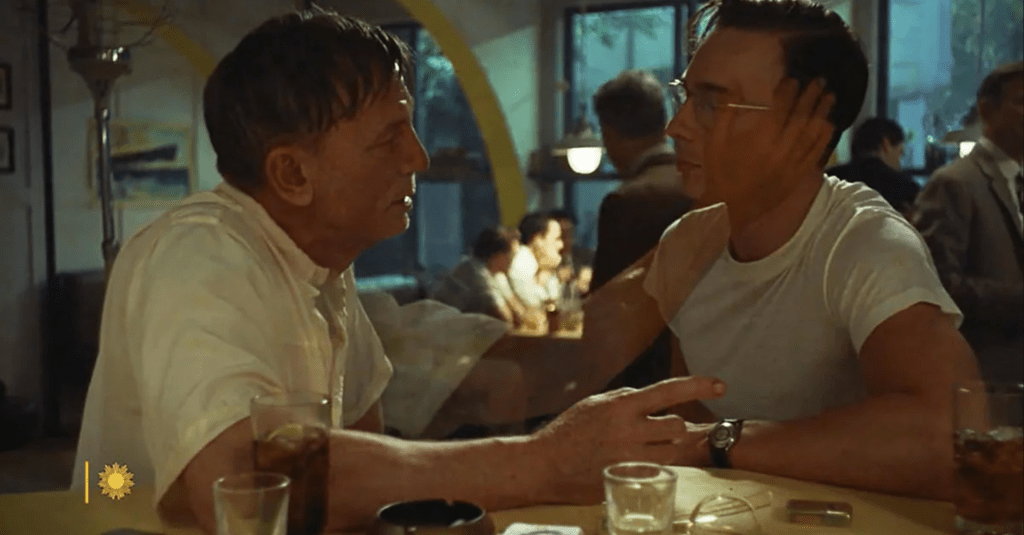
The scenario is deceptively simple – based on the William S. Burroughs novel of the same name, Queer is the story of William Lee (Daniel Craig), an American expat living in Mexico (and blatant self-insert for Burroughs himself). While the film features other characters, make no mistake – it is about Lee and Lee only. He is the only character whose thoughts and feelings we are privy to, everything that happens in the film filtered through his flawed, addled perspective. Lee is a masculine gay man who is well-known in the small community he inhabits in Mexico City – when we first meet him, he is striking out with a couple of young Americans before settling for a one-night stand with a local boy. Despite his own sexuality, Lee often comes across as homophobic, declaring himself to be a separate breed from the other queens and queers of Mexico City. Openly referring to himself as a pervert and projecting an image of gung-ho masculinity (even carrying a gun everywhere he goes), it is clear that Lee struggles with self-hatred – the conflict between his desires and his shame driving him to distraction and to drugs. His manias are quite stunningly visualised – a moment of dissociation shows him physically fading away like TV static, while early scenes with romantic interest Eugene (Drew Starkey) are layered with disembodied, ghostly limbs that reach out and touch the younger man in the ways that Lee wishes he had the courage to. Daniel Craig walks a dangerous tightrope with his performance, sprinkled with tics and mannerisms that border on the absurd, but it works when you realise that this is a man who is almost never able to be his real, authentic self. Everything he does is performance, deflection, a precarious image that he maintains out of fear. The only times he seems at ease are when he is making love, giving himself over fully to his true self. After bedding Eugene, he becomes obsessed, pushing the younger man for more time together, both sexual and casual, thriving on the fleeting sense of normalcy that a regular relationship gives him. But Lee has made a fatal error – he has fallen in love with a person he cannot understand.
As I said before, the film is firmly about Lee, with the supporting cast never receiving much attention beyond their immediate impacts on his day-to-day doings. Lee is the centre of the universe, with other people existing only in orbits of descending importance – his fellow American queers receive names and thin characterisation, the local Mexicans pop in and out as background fillers and occasional brief encounters for service, while the Natives of South America, despite ostensibly playing an important role in the film’s final act, are practically non-existent to Lee. Only Eugene, the target of his affection, receives any sort of major attention from the film – it is precisely this attention that allows us to understand why their relationship cannot work. Drew Starkey plays the role with a reserved elegance, a firmness of posture and perpetual faint smile that calls to mind a work of art or sculpture. This makes perfect sense – Lee initially sees him as a distant object, a thing of beauty he is too afraid to approach. Eugene is friendly and relaxed, proving surprisingly open to the clumsy advances of his new friend, but he never loses that detached aura that surrounds him. Despite having graphic sex with a man, it remains unclear whether or not Eugene is actually queer, or at least to what extent he is. At the same time as his hook-ups with Lee he maintains a seemingly steady relationship with Mary (Andra Ursuta) a red-headed girl who haunts the local gay scene and who makes a startling and ambiguous appearance in one of Lee’s surreal nightmares. Eugene’s inscrutability can be frustrating for the viewer, especially in the film’s second half, where the two men travel to South America together and abandon the rest of the supporting cast. Lee’s condition deteriorates as he suffers withdrawal from opiates and pines endlessly after Eugene, who he has practically blackmailed into joining him on this adventure, while Eugene remains so calm and cold that you may begin to wonder why he came along in the first place. Of course, this is very much intentional, all a part of the film’s laser focus on getting us into Lee’s head above all else. We cannot understand Eugene because Lee cannot understand Eugene. This is why Lee is hunting for a rare jungle plant that is said to grant telepathy – to speak without words and finally know this other soul that has eluded his attempts to communicate. In the same way, the film does much of it’s communication through image and music, attempting to touch something deeper than mere dialogue. This noble goal, however, is where things fail to coalesce.
I must admit I admire the effort, and there’s nothing technically wrong with how the film attempts this communication. If anything, it stands as one of the most ambitious and beautifully executed works of the year, if not the decade so far. Mexico and South America are rendered almost as dreamscapes through surreal colour choices, varying depth-of-field and the use of miniature backgrounds creating a subtly fantastical vibe. The immediate space that the characters inhabit is sweaty, intimate and tactile, while everything surrounding them is like a world of candy-coloured toys, distant and untouchable. While the original score by Trent Reznor and Atticus Ross is superb, the anachronistic soundtrack becomes overbearing, crammed with just a few too many attention-grabbing songs. While many of the needle-drops work as intended, such as the brilliant use of ‘Come As You Are’ during Lee’s initial sighting of Eugene, there are many moments where traditional scoring would have been more appropriate. And while the editing is sharp and snappy, it also creates a fragmented, elliptical flow that only highlights the ultimate plotlessness of the film. Each scene is like a self-contained vignette, and while there is logical progression of one scenario to the next, it contributes to the feeling that the film never really opens up and shares a final, comprehensive thesis. I’m left in the awkward position of understanding the film but not “getting” it – Queer displays incredibly straightforward thematic aspirations, but is so overtly strange and elusive in its construction that the intended experience becomes something you can see and hear but not quite feel. The fact that the emotional pay-off lies just out of reach makes the entire final act and epilogue more of a chore than they should be, blunting the potential impact of the most visually surreal sequences in the film as the realisation dawns that there will be no great catharsis. If you’ve paid the film any sort of attention, the conclusion will hold no great surprises for you, and Guadagnino’s flashy, highly visual style all but guarantees that you will have been paying attention.
This lack of satisfaction wouldn’t be so disappointing if I hadn’t found myself so invested in the magical world that Queer creates. The film is far from dull, always presenting us with some arresting image or another, and Daniel Craig’s performance is a rock-solid foundation that the film builds its intrigue outwards from. If not for the fundamental empathy it inspires towards this difficult, self-destructive character, there would perhaps be no reason to engage with the abstracted, roundabout storytelling. In that sense, the disappointment of the resolution can be viewed as an endorsement of the rest of the work – It made me care enough to be upset that I ultimately didn’t care, or at least not in the way it seemed I was supposed to. I’ve seen many glowing reactions that emphasise the parallels with and allusions to author William S. Burroughs’ own life, with many describing the film as being “haunted” by him. It may well be the case that this context is what unlocks the film’s final secrets – but it is a context that I am not privy to, and so it cannot factor into how I experienced the story. Queer is still one of the better films of 2024 and a worthy contender in whatever Oscars categories it winds up nominated in – but it’s not the Guadagnino film that really deserves to be in the race. 8/10.

 Oscar Talks Movies
Leave a comment