by Oscar O’Sullivan
Monday – You Only Live Twice
Bond cuts straight to the chase this time, already loving up an exotic lady the instant he appears on screen. You Only Live Twice is very much playing the hits – a dangerous vacation to a stunning locale where Bond teams up with local intelligence, uncovers corrupt corporations and takes flight in an improbable machine for an explosive arial dogfight. SPECTRE are back at the forefront, though they seem diminished from the omniscient master planners we glimpsed during prior adventures. Gone is the sinister board of international agents and the sense of plans within plans – now it seems to merely be Blofeld and a cadre of spineless supplicants banking it all on a single master plan, a plan that’s impressive in its ambition though not exactly riveting in its execution. Blofeld himself is magnificent in the flesh, played with sinister aplomb by Donald Pleasance. The unplaceable accent, seemingly paralysed arm and his manic, piercing stare create quite the impression, even if we only get to spend about ten minutes in his presence and he acquits himself quite poorly in his attempts to end Bond – even the comically incompetent Goldfinger made a better stab at finishing off 007 two films ago. While this one is a little rough around the edges visually, you can forgive it for buckling under the weight of its ambitious setpieces. While nothing tops the outrageous underwater finale of Thunderball, there’s still plenty of impressive battles to be had – the above-mentioned helicopter dogfight is the clear standout, but it wouldn’t do to dismiss the warehouse chase, the one-on-one office brawl, the various ninja training scenes and the finale, which just barely avoids tipping over into absurdity. The script is a mess, the energy is flagging and Connery already had one foot out the door, but even with all that against it this is still a rock-solid action adventure. 8/10.
Tuesday – It Happened One Night
A wonderfully fluffy, witty and charming road-trip adventure, a journalist and an heiress thrust together by fate on the run from her overbearing father. Peter (Clark Gable) is a world-weary, quick-witted journalist whose career is on the ropes, while Ellie (Claudette Colbert) is a spoilt rich girl marrying a man her daddy can’t stand. She doesn’t have a clue how to navigate the world on her own, he can get himself an exclusive story by shepherding her across the country – it’s a match made in heaven. Of course it’s far from plain sailing – at times they seem liable to bite each other’s heads off – but it’s all in good fun, with each slowly learning to understand the other. It’s just a touch bawdy, enough to add a dash of spice to an otherwise chaste courtship. It does the best it can to make the trip feel like a whirlwind tour of rural America, but there’s only so much you can do when you’re bound to studio sets. The gender dynamics are pretty outdated, the resolution stumbles over itself before spinning into a final satisfying punchline, but it’s all good clean fun. They don’t make them like this anymore, and they certainly don’t shower them in Academy Awards either – this is one of only three films to ever win Picture, Director, Screenplay, Actor and Actress. Not bad for a breezy light-hearted rom-com. 8/10
Wednesday – A Serious Man
The Coen Brothers have always grappled with the unknowability of the world in their films, torturing their protagonists with existential uncertainty. Never has this been more true than in A Serious Man, which consists of nothing but torturous moral quandaries and looming, nameless dread. Larry Gopnik (Michael Stuhlbarg) is a professor of physics who openly admits that he doesn’t really understand how what he teaches works, he just accepts that it does. This makes it ironic when his dull, well-ordered life stops working, leaving him clueless as to both the how and why it all went wrong when his wife (Sari Lennick) announces that she’s going to leave him for his colleague Sy Abelman (Fred Melamed). Larry’s flabbergasted reaction sets the standard for the rest of the film – personal disaster after personal disaster washing over him and leaving him desperately searching for any sort of answer. Most maddeningly, nobody else in his life seems to understand or even care about what he’s going through. His kids are apathetic to the collapse of their household, wrapped up in their own inane teenage woes. Most everyone he speaks to is either presenting him with a new problem or asking him why he’s so bothered by the ones he has. His brother Arthur (Richard Kind) is his only companion through the worst of his troubles, and also only adds to his unease – he’s a socially stunted man-child obsessed with an arcane numerical system that he claims can explain the entire world, yet another mode of meaning to confound Larry. Even his faith fails to offer a semblance of an answer, multiple Rabbis attempting to placate him with learned anecdotes and simple platitudes that only exasperate him further. Sy Abelman becomes the main target for Larry’s psychoses, an overbearingly charming and intelligent fellow who has seemingly stolen the life that Larry wanted for himself – his exit from the plot partway through only unmoors poor Larry further. Each time Larry thinks he’s approaching some kind of meaning or answer, the universe kicks him down again. Somehow it never becomes enough of a pattern to lose its effectiveness, throwing the audience for just as much of a loop as Larry, placing us right in the centre of his madness as a participant rather than an observer. Stuhlbarg is superb, somehow maintaining a permanent deer-in-the-headlights frightful look throughout the whole film. He stammers and shouts and puts his foot down over and over again but fails to assert himself in any real way even once. He is not, obviously, a serious man. Futile, impotent, spineless, pathetic, helpless to understand or improve his situation. Perhaps he simply thinks too much. Ignorance is bliss, as they say. Not only do the Coen Brothers refuse to provide an answer, they refuse to even comment upon the idea – never have I seen a film presented with such brutal neutrality. An achievement in frustration. 9/10.
Thursday – Apocalypse Now
Always a delight when you watch a film with a titanic reputation and discover it really is as good as all that, if not better. A rarity among war films, in that it succeeds in making the violence entirely repulsive – surprisingly difficult even for the most avidly anti-war efforts. It’s not simply the way that Apocalypse Now performs violence, but the context that this violence is performed in that allows it to succeed where many similar films have failed. Vietnam is, in a word, absurd – a world of surfing-obsessed colonels, flying cows, visits from Playboy bunnies and nightmarish outposts where nobody knows who’s in charge or what they’re firing at. The unexamined insanity of everything that takes place creates a deeply unsettling tone, especially since the film’s hero seems completely unbothered by what’s happening – Martin Sheen’s voiceover offers no judgement, only reflection, especially as he becomes more and more obsessed with his eventual target, Colonel Kurtz (Marlon Brando). Kurtz has gone rogue in Cambodia, his methods disturbing the top brass, prompting them to send Sheen’s Captain Willard to put him down. But Willard isn’t exactly mentally stable himself, having come back to Vietnam for a second tour after failing to readjust to civilian life. Did the generals know that they were sending one potential psycho to kill another? Perhaps that was the point of his selection, a solider they can trust to follow through but who they don’t necessarily want coming back – efficient and expendable. His hapless crew don’t even know what they’re risking their necks for. The closer they come to their target, the more deranged the world around them becomes, the more unstable they all grow – except for Willard, who proves disturbingly level-headed during horrible moral dilemmas. The film is an episodic odyssey that never feels segmented or stop-start, largely thanks to the ethereal editing work. Images fade over and through each other, layered to create new meanings, warp time. Another key ingredient in the gripping atmosphere is the soundtrack, a blend of period-accurate musical cues, classical themes and, most evocatively, droning synthesiser music. Madness permeates every level of this film, but it is a controlled, deliberate madness. A miracle that it even exists, let alone in such a complete and comprehensive form. 10/10
Friday – Gladiator II
Spoiler review here.
Saturday – Carlito’s Way and Training Day
A decade on from Scarface, star Al Pacino and director Brian De Palma re-teamed for Carlito’s Way, which is practically a spiritual sequel to the gangster classic. Pacino is once again playing a Hispanic drug runner, only this time, his character didn’t go out in a blaze of glory – we meet him emerging from a five-year stint in prison, declaring that he’s leaving the criminal life behind and going his own way. What follows is a surprisingly low-key affair for both star and director. Pacino was in the peak of his insane overacting period, and while he still has his moments, he’s comparatively gentle here when viewed next to his work in Heat a few years later. Carlito is something of a legend in the New York crime scene, much to his chagrin. Trying to go legit as a club owner, he nevertheless is bothered by a revolving door of criminal elements – from cocky hustlers like Benny Blanco from the Bronx (a hilarious John Leguiziamo) trying to use him to make a name for themselves, to the D.A.’s office scrounging for any excuse to put him back behind bars. Even his own lawyer, David Kleinfeld (Sean Penn), becomes a thorn in his side, dragging him inexorably back towards the life he’s fighting to leave behind with a hare-brained scheme to rip off a dangerous mob boss. Complicating matters further is Gail (Penelope Anne Miller), Carlito’s old flame whose heart he already broke once when he was put away – how can he promise her the same thing won’t happen again when he refuses to change who he is? Because that’s what really holds Carlito back form escaping the life of crime – even his attempts at cleaning up his act are laundered through his old criminal connections. The bar he manages is a mob bar, he remains friends with the criminals he came up with. Even though the world hasn’t changed all that much in the time he spent in jail, he still doesn’t recognise a lot of what he sees – codes of honour that he once lived by now seem dated and destructive, the same cocky swagger that made him famous in the underworld now an annoyance that he’s rid himself of and that he despises in others. De Palma shoots the film with solemn, encompassing eye – while there are still moments of operatic, Hitchcockian excess, this is otherwise one of his most visually conservative works, though no less stunning for it. He captures the beauty of rain-soaked nighttime streets, the sweaty exuberance of packed nightclubs, the claustrophobic discomfort of a prison visiting room. If Scarface was tragedy in the traditional dramatic sense of word, Carlito’s Way is tragedy in the more colloquial meaning – a man who wants to do better, who deserves to walk away from all this, dragged down and down into the filth he tries so hard to reject. A tragedy of circumstance, with a top-rate central performance, a stacked supporting cast and one of the great American image-makers at the helm. 10/10
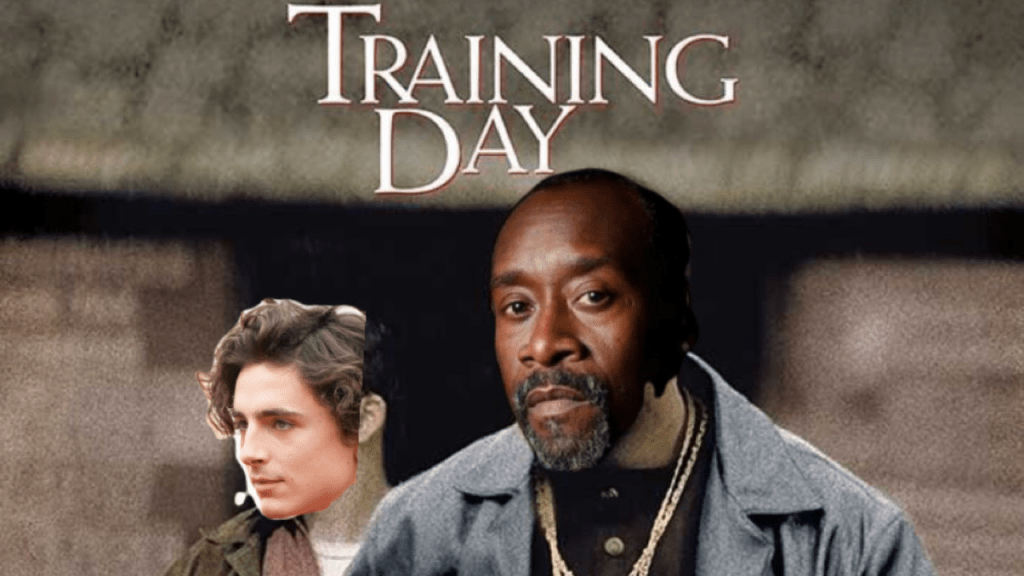
You may have heard the phrase “a stupid person’s idea of a smart movie” thrown around in film criticism before. It’s a method of approach I dislike – I think criticism should stem from your own perspective, not the imagined “wrong” perspective of some hypothetical second person – but I couldn’t avoid thinking of it when considering Training Day, a film that is hailed as a gripping socially conscious masterclass and which I thought was as dumb as a box of rocks. Everything that happens is blindingly obvious – from moment one we understand that Denzel’s crooked cop is bad news, with every single scene in the first half being another moment of open corruption or brutality for Ethan Hawke’s rookie to passively absorb. Yet for all its posturing about morality in policing, it doesn’t have any meaningful commentary to offer on the subject, devolving into a black-and-white good-vs-evil action thriller where the outcome isn’t even fully in the hands of the hero. However, the film remains a lot of fun despite those shortcomings. Denzel devours his villainous role, twisting his natural charisma into smug intimidation, making a cartoonishly evil character compelling through sheer force of will. Ethan Hawke almost holds his own as the wide-eyed rookie, becoming especially gripping during the brief scene in the middle of the film where it seems to be going somewhere. It’s also visually engaging, gritty and dynamically shot, lending much-needed texture to the otherwise stereotypical world presented. None of this can save a fundamentally broken script, but it does make for a decent in-the-moment experience, though without any real staying power. If Denzel hadn’t won the Oscar for this, I doubt it would be so fondly remembered. 6/10. There are much more fun mediocre Denzel actioners that aren’t half as highly regarded. Give Virtuosity a go – a sci-fi thriller with Russell Crowe as an insane AI murderer. Or watch the genuinely exceptional Ricochet, which seems to be enjoying a minor revival in interest online.
Sunday – The Adventures of Baron Munchausen
From the twisted mind of Terry Gilliam – wonderful fun. It’s cliched to use the term visionary, but Gilliam is one of the few directors where it’s truly applicable. The world he’s created here is a joyous hodgepodge of scattered mythologies, half-remembered fairy tales, gleefully inaccurate histories and pure unfiltered absurdism. Elderly adventurer Baron Munchausen (John Neville) must embark on one final fantastical odyssey to gather his old allies and defeat the armies of the dastardly Sultan to save a society that doesn’t even believe in him anymore. We follow him to the surface of the moon, through the inside of an active volcano and into the belly of a whale, with a wonderful cast of comical characters popping in and out along the way. It’s almost so whimsical as to defy any deeper meaning, though there is the hint of depth to be found – the Baron is shadowed on his journeys by the spectre of inevitable death, while much is made of how there’s no place for improbable people in a rational world. What’s most compelling is the pure joy of the practical filmmaking, with intricate sets, elaborate costuming and delightfully blatant special effects wizardry. Yes, you can tell exactly how they achieved the floating head effect for Robin Williams’ King of the Moon character, which makes it even more of a delight to watch him bob around. I dare you to watch the final action set-pieces without smiling ear to ear. Filmic Fairy Tales is a sub-genre I adore, especially when they’re made with this much heart and style. 9/10.
 Oscar Talks Movies
Leave a comment