by Oscar O’Sullivan
Ah, the post-Oscar film. When you’ve reached the very peak of your craft, where is there left to go? Down, inevitably, though often through no fault of the actors who have starred in disappointing post-Oscar films. After all, the lengthy production cycle of a feature film often means these follow-ups were usually shot months and moths before the actor in question took home gold and saw their clout skyrocket, which can make things embarrassing when their next appearance after an award-winning turn is a crummy cash-grab money job. While nothing could possibly live up to the dizzy heights of Oppenheimer, to say Cillian Murphy is slumming it would be beyond unfair – he’s taken his time and come back with a small-scale passion project that feels worthy of Ireland’s first Best Actor winner, and hopefully bodes well for the future of Irish filmmaking as a whole.
I saw Small Things Like These in the biggest possible screen, Omniplex’s MAXX, and was stunned to find it jam-packed – especially since I had just walked out of a near-empty small screen showing another adult drama, Juror #2. It’s wonderful to see tangible proof that there is an appetite for original Irish stories on our screens. The opening weekend box office is also shockingly high for a limited release drama film, a tidy million euros, sitting pretty at number 4 on the UK and Ireland charts. In fact, it’s only about a half a million euros behind A24’s Heretic, which had a similarly sized marketing campaign and is playing in over double the screens. It will be interesting to see how the film fares when it opens in the states tomorrow – Yanks may not be in the mood for a serious, downbeat drama at the moment. Distributors Lionsgate must be betting on that Oppenheimer bump to get the crowds out, as well as the strong critical reception and potential awards buzz.
Still, this is an Irish story for Irish people and it’s more than succeeded in reaching the target demographic. Every Irish person should at least be aware of the film’s subject matter, the Magdalene Laundries – Roman Catholic institutions where generations of women were imprisoned and abused, an open secret that remains one of the blackest stains on our country’s history. The film doesn’t show much directly, but even the brief glimpses protagonist Bill Furlong (Murphy) gets of the local convent’s inner workings are enough to send him into a guilt-ridden spiral. A husband and father of five girls, Bill has a responsibility to his family – but he can’t help but feel a responsibility to these other girls too, a complicity in their suffering. His wife Eileen (Eileen Walsh) puts up with his gloomy moods, commenting that he’s “always been soft-hearted”, but tells him in no uncertain terms that “there are some things you have to ignore”. In a way, she’s right – for most of Irish history, the Church was the cultural centre of the world. They were community leaders, highly respected figures. They gave mass, they ran the schools, they supported local businesses – and a man who rocked the boat could see himself cut out of all of that, as Bill learns during a chilling sit-down with the imperious Sister Mary (Emily Watson) after he finds one of the nun’s girls locked in a coal shed.
The film makes no effort to explain or examine the actions of the nuns, nor should it – there is no excuse for what took place, and to try and absolve some individual members or allow the institution to justify it’s position would be missing the point altogether. Sister Mary is sinister and intimidating because of the context we find her in, not because she is played as a monster. Emily Watson gives a severe but restrained performance, a woman who is too secure in her position of power to be worried or angry. She knows that her institution is safe because it’s simply the way things are, she sees no issue with treating the girls like slaves because that’s simply the way they must be treated, she sees no threat from Bill because he knows how things will go. And if everyone believes that change is impossible, then that’s how it is – they let the small things go and are thankful they aren’t the ones suffering.
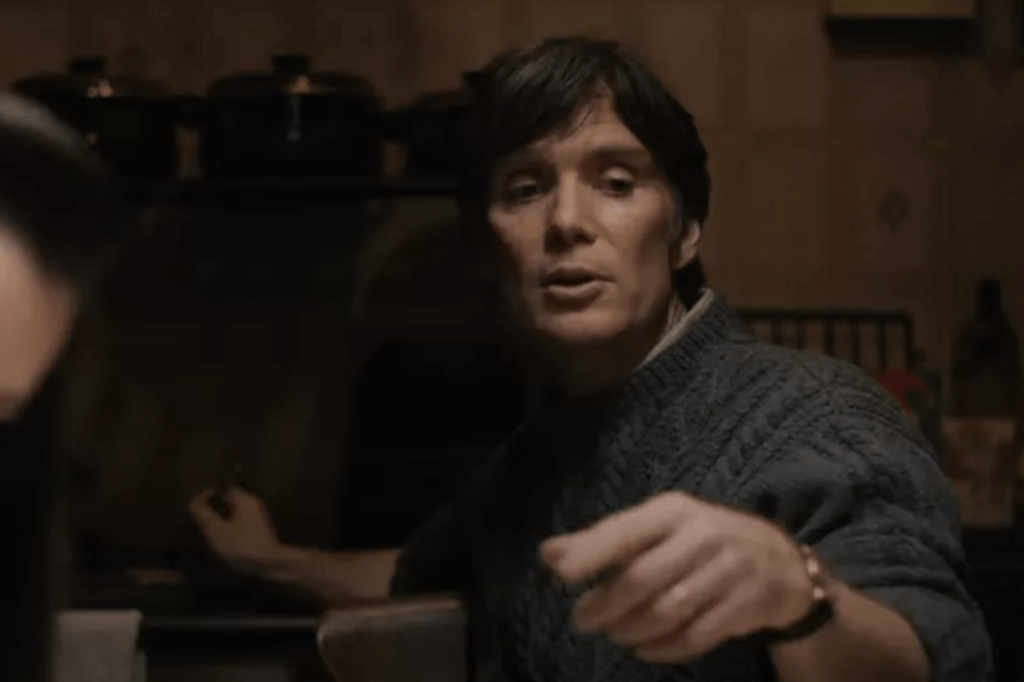
It may seem redundant to say that a Best Actor winner gives a good performance, but nevertheless, Cillian Murphy is excellent. Bill is a warm and popular man, but also a quiet one, prone to introspection and long spells of silence. He’s often seen with a far-away look as his memory drifts back to his own childhood, bittersweet recollections of the big house his mother worked in and disappointing Christmases, coming up unbidden and mingling with the turmoil of the present moment. The film often frames him as an observer, an outsider, lurking in doorways and gazing through windows as he witnesses injustices he’s powerless to stop. Murphy plays the emotion perfectly, naturalistic and understated – no wailing or snot-bubbles to be found here. He sits in a barber’s chair with a single tear running down his face, remembering how his uncle took him to get his hair cut as a boy. In the convent, confronted by a ragged cleaning girl begging him to take her away, his voice trembles as he stammers out “it’s not up to me, love”. Around the nuns, he hunches over and shrinks in on himself, completely cowed by their authority. It’s a fully realised performance, a strongly-drawn character who acts as our own emotional window into the ideas of the story. He thinks of his own girls, how lucky they are to have a home and parents to care for them, and at the same time reproaches himself for that thought – if his girls were in that convent, wouldn’t he want someone so speak up for them? Or is everyone only obliged to look after their own?
Despite being firmly grounded in this one historical phenomenon, it’s a film that tackles relevant ideas – how do we live with the injustices we know we can’t change? To ignore them would be callous, but to dwell on it will drive you to distraction. In the modern day, through the miracle of the world wide web, we are bombarded constantly with images and videos of atrocities taking place a million miles away. What can we do? The film ends on a hopeful note, a small moment of victory in the face of helplessness, but the feelings it dredges up are something we all must face on our own terms. Small Things Like These is a deeply moving, expertly crafted film that bodes well for the future of Irish storytelling – not just that we can get films of this calibre made, but that we have come far enough as a people to tell stories like these. No more silence. 9/10.

 Oscar Talks Movies
Leave a comment