by Oscar O’Sullivan
As a kid growing up in the 2000s, watching a movie was a very different experience than it is today. Streaming was barely an idea yet, my TV options were Dora and Blues Clues, and the cinema trips were a relative rarity. DVDs were where it was at, a big silver box full of half-heartedly catalogued discs that I would watch over and over again without ever getting bored. I had the Disney classics, Pixar and Dreamworks and some other animated ephemera, but what was really special was the small selection of live-action movies that I was allowed to watch. Star Wars, of course, was on the menu as soon as my Dad figured I could sit still for long enough, and Lord of the Rings soon after. Above all there were the superhero movies – Spider-Man, Fantastic Four, and of course, the X-Men trilogy. I adored X-Men for how dark and mature they were compared to everything else I watched growing up, violent and provocative in a way that I didn’t fully understand but that drew me to them in a different way than the joyous sincerity of Spider-Man or the endearing goofiness of the Fantastic Four duology. Seeing X-Men Origins: Wolverine in the cinema was a glorious experience – my favourite X-Man getting a film all to himself. I still love that movie to this day. Even as the Marvel Cinematic Universe kicked into top gear and took over my life from 2012 to 2021, I was always happy to check back in with my mutant pals. The Fox X-Men franchise offered something different from the uniformity of the MCU – it’s highs soared so much higher than it’s more consistently average contemporary, and when they started failing towards the end, they failed in interesting, entertaining ways. Deadpool was the second “grown-up” movie I watched in the cinema – Logan was my favourite movie for a long time – I even have fond memories of seeing The New Mutants on my first post-COVID holiday. All this is to say, those movies mean something to me, they’re something I still revisit and enjoy fairly regularly (where are my X-Men: Apocalypse enjoyers at?). So as a Fox X-Men kid, a comic book nerd and a (lapsed) MCU super-fan, you will know that I am the exact target audience for Deadpool & Wolverine – and I thought it was pure shite.
The Deadpool character is the ultimate adolescent superhero – he’s relentlessly funny, excessively violent, makes pop culture references that immediately date any comic he appears in but made him excellent meme fodder in the early internet. A bastard amalgamation of Spider-Man and Wolverine with a ‘too-cool-for-school’ aura, most everyone who was ever a teenage boy likely considered him their favourite character at one time or another. There is also depth to be found in the way some writers use him, examining his mental illness or how his softer side and desire to be better is constantly beaten down and repressed by his environment and the expectations of others, but the films have largely failed at finding this nuance. The blame should be placed squarely on star/producer/writer/gin salesman Ryan Reynolds, who has been the champion of the character’s cinematic life since day one, for better and (mostly) worse. He’s the perfect man to play the character, and I mean that as an insult. He’s one note, constantly on, a hyperactive clown who never shuts up but also says nothing of value, just the same tired gags washing endlessly over you until you become numb to it all. This third entry pretends to be offering a new angle on the character, attempting to convince you that his arc is that he must learn to accept being unimportant in the grand tapestry of the “Sacred Timeline” and focus on the people that matter to him most. None of this rings true in the movie because Wade Wilson, more than ever, is not a real person with thoughts or feelings – he’s a walking punchline who knows he’s in a movie and thus is completely irreverent about everything that happens. If anything, his devotion to his own small circle of friends makes him seem more selfish than ever, as he manipulates and murders his way across the multiverse while proclaiming himself to be “Marvel Jesus” – it may be meant as a joke, but the franchise has absolutely brought him in as a ringer to save their faltering image. Reynolds has brought along his pet director Shawn Levy for the ride, a middling children’s filmmaker whose artistic peak was the Night at the Museum franchise and who brings nothing to the table for this R-rated comedy – if anything, this is the most juvenile entry in the trilogy. Most of the violence comes in the form of digital blood splatters that you could easily scrub out for a kid-friendly version of the same action scenes, which are all weightless whirling disappointments full of digital body doubles and egregious sped-up slow-mo. The only other “adult” element is the serious case of potty mouth that all the characters have, effing and blinding their way through every scene and making crude sexual remarks, though of course nothing sexual happens onscreen to back up all this talk. There’s also a distractingly conservative bent to a lot of the humour, making cracks about being cancelled by the Woke Mob and really laying it on thick with schoolboy-level gay jokes to the point of feeling genuinely homophobic – I’d like to give the five(!) credited writers the benefit of the doubt here, but it needed to be balanced with some kind of genuine representation or at least some amount of awareness about how bad it came across. Much more thought went into the meta-humour and the extended allegory of ‘failed universes’ as a stand-in for the supposedly forgotten pre-MCU Marvel films – nevermind that in the same breath the film asks you to be reverent of the return of these characters, chief among them – well, you already know.
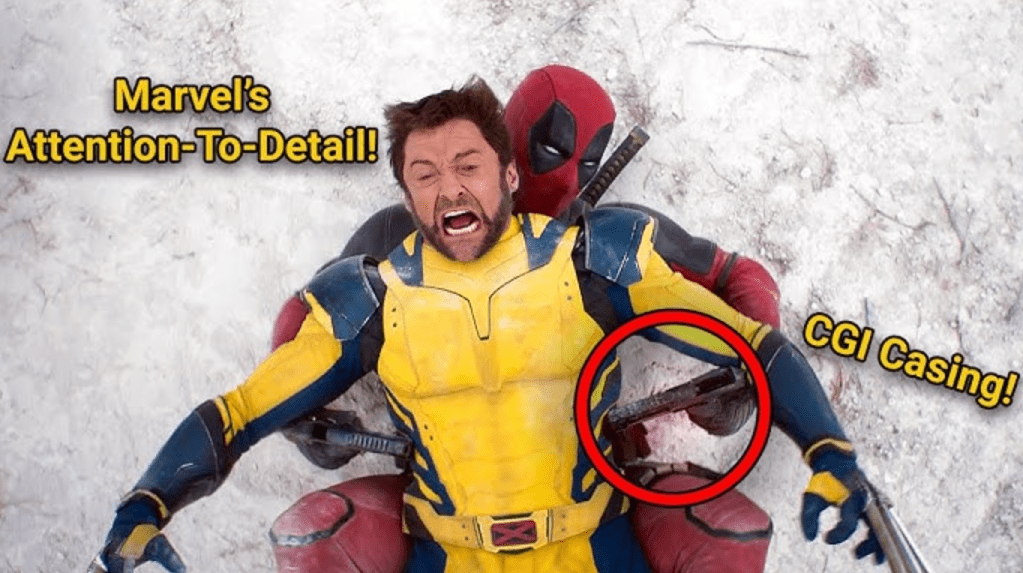
I don’t necessarily blame Hugh Jackman for coming back – I don’t respect it, but I understand it, and he’s done an admirable job pretending that his return was either logical or necessary. At least the return of Tobey Maguire and Andrew Garfield was (nominally) a surprise and included as a natural part of a story with more going on. The return of Wolverine is so nakedly mercenary it makes my skin crawl, nostalgia purely for it’s own sake with nothing to say, no new angle or reinvention to justify this pandering return to something we had all quite happily left behind seven years ago. This film doesn’t desecrate or devalue Logan, but it does spit on the very idea of finality in storytelling – if no-one’s ever really gone, how are we supposed to believe in any of this ever again? The way the film uses Wolverine is exceptionally boring – a “new version” of the character we all know and love is yoinked from his failed timeline and set up as a grumpy foil to Deadpool’s antics. It’s a dynamic that’s never built up or examined by the text of the film, instead relying on the audience’s preconceived notions of what relationship these characters should laugh. Screenwriting 101 – let the audience do all the work for you. There’s never any good reason given for Logan to change his mind about Wade – he hates his guts right up to the final set-piece, when suddenly he begins treating him with a gruff respect. It’s sappy, it’s unearned, it made my eyes roll back in my head as the power of their friendship defeated the otherwise invincible villain while an orchestral pop song with no lyrical relevance to what happened onscreen blared over everything. To circle back to the action for a moment, the film accidentally proves why Jackman needed to retire in the first place – he’s too old to be doing the type of stunts and choreography that made his portrayal so iconic to begin with, so now he’s reduced to frantically stabbing at foes while standing still with any and all complex movements being handled by an entirely digital body-double, which is most obvious during the final brawl where he finally puts his mask on to hide how little Hugh is actually involved in this choreography. He also doesn’t take it off for the rest of the film’s finale, meaning half his face is obscured for the emotional climax of the story. That brings us to the costume, hyped up extensively even within the film as the long-awaited “comic-accurate” look that fans have been begging for Jackman to wear. It might be the worst Jackman’s Wolverine has ever looked on-screen, an over-designed mess that adapts the broad strokes of the iconic blue-and-yellow costume while also morphing it into a generic armoured supersuit that could be recoloured and applied to any character. What makes it bizarre is how successful they were with some of the other costumes in the film. Not only is this the best the Deadpool suit has ever looked, one of the alternate Wolverines we see a glimpse of wears a much more elegant take on a comic book costume, a sleek and simple leather version of the orange-and-brown suit designed by John Byrne. If the film’s main suit used those same materials it would be better, but instead we’re left with a guy who’s whole thing is being immune to injury wrapped up tight in layers of goofy armour plating. Deadpool jokes that Disney will be bringing Jackman back until he’s 90, but it’s not a joke, not really – it’s a promise that you’ll never have to say goodbye to the things you loved as a child, never have to engage with some new or different version of something you grew up with.
Every other element of this film is secondary, an afterthought, set dressing for a buddy-comedy where the two leads are neither believable as friends or in any way funny. Deadpool’s entire supporting cast from the previous two films are waved in our face as being his big motivation, but are only wheeled out for two brief scenes where they get a line each. His love interest Vanessa has even less to do than in the film where she was dead for most of the runtime, taking a character who was vital to selling the first film as an off-colour romcom and reducing her to a source of self-pity for the hero (and a reassurance that despite all of his fruity humour Deadpool is very much a hetero, don’t you worry). His other supporting players like Negasonic Teenage Warhead, Yukio and Colossus were fan favourites who have been brushed aside in favour of Peter, the joke character who went viral during the marketing for the second film. The gag was funny eight years ago – now it just feels lame when the one-note nice guy is the only one who even appears at the final battle to resolve things with a joke. Completely absent without explanation are Domino and Cable, two characters so popular and well-received in the previous film that people were immediately clamouring for them to join the MCU. Jettisoning them in favour of Wolverine and a cavalcade of second-rate cameos says everything you need to know about the film’s intentions. Not a single mention is made of Wade’s best friend Weasel, played by persona-non-grata T.J. Miller in the prior films. Rather than pouncing on an opportunity to mock the ex-cast member, the writers are content to sheepishly pretend he never existed, which speaks to the cowardice that underlies all of the so-called satire in the film’s writing – they’ll even allude anything that could actually get them in trouble. The film’s new additions, the two antagonists, are given nothing to work with. Matthew Macfadyen is entertaining as camp time-police villain Mister Paradox, who acts as a limp stand-in for corporate interests as he prepares to eliminate the Fox X-Men timeline for being “boring” compared to the glorious Sacred Timeline of the MCU. Again, the film wants you to think it’s having a laugh, but the people they’re meant to be mocking signed off on this – the real joke is on us for lapping it up. The true villain of the piece is Emma Corrin as Cassandra Nova, Charles Xavier’s evil twin sister who has lived her entire life as the queen of the desolate void. It’s an excellent OTT performance, unrestrainedly twisted without becoming silly, but it’s absolutely wasted on this film – she exists here only as a super-powered obstacle for the leads, her backstory and motivations being meaningless outside of their intended context. Put this same actress and character into a genuine X-Men film and it would be one of the great comic book villain performances. Here, it’s just a footnote, a name plucked from a wikipedia page to give nerds another comic book connection to babble about.
Deadpool & Wolverine claims to be giving an ending to the maligned and left-behind Marvel heroes – but this is utterly disingenuous. Nobody gets to have an ending anymore, except maybe being killed as a joke. Just look at the big news from Comic-Con at the weekend – Robert Downey Jr, whose death in Avengers: Endgame was the emotional capstone of the 10-year MCU experiment, triumphantly returning to play Doctor Doom because Marvel has completely failed to innovate or convince audiences that new stories are worthwhile. In a way, I’m thankful to this movie – this type of nostalgic pandering may never work on me again. Even more than the ghoulish and half-hearted nostalgia of The Flash, which was at least trying to tell a story before being swept away by corporate meddling, Deadpool & Wolverine reveals how shallow and manipulative this modern obsession with “legacy” in media truly is. You may say that I’m being harder on this movie because of my attachment to it’s source material – if anything that should make my criticism even more valid. I am the target audience. This film has been designed in a lab to pander to my tastes, my emotions, my childhood – so why did I feel nothing but revulsion? The credits roll over a sappy montage of behind-the-scenes footage from the Fox Marvel franchise. Those are the movies that made me. In a vacuum, presented in a different context, the tribute may have moved me. As an epilogue to a cynical, winking, dishonest, and just flat-out badly made two-hour-long effort by a corporate monolith the make me feel warm and fuzzy about the flattening of culture via endless mergers and buyouts? I didn’t even blink. 2/10.

 Oscar Talks Movies
Leave a comment