by Oscar O’Sullivan
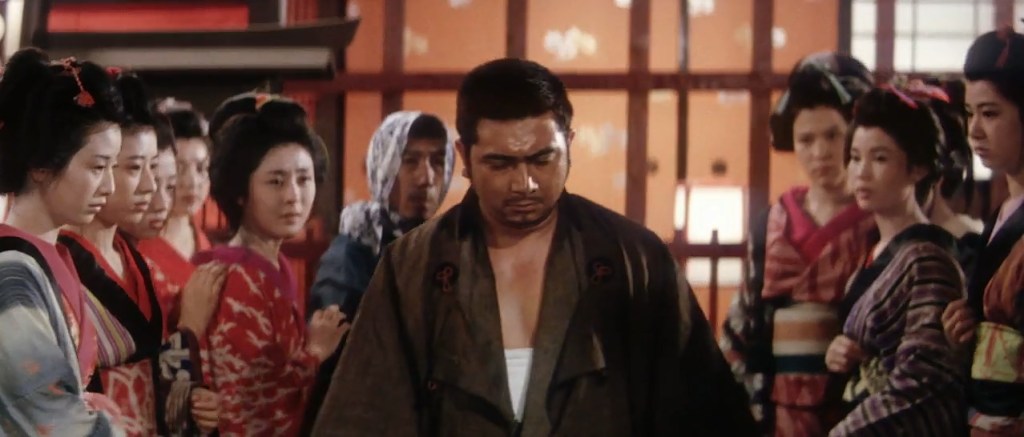
Beginning in 1962 with The Tale of Zatoichi, the Zatoichi film franchise released twenty-five films in a span of only eleven years. Zatoichi’s Revenge, the tenth instalment, released in 1965. Ten films in three years may not seem that intensive from our modern viewpoint, where two or even three films a year was recently the norm for certain franchises. What makes the rate of production for Zatoichi truly impressive is that Zatoichi himself is played by the same actor each and every time, Shintaro Katsu. It’s incredible that, ten films in, his performance shows no signs of tiredness or boredom. Maybe playing this character so regularly allowed him to hone and reinforce the fundamentals of the performance in a way rarely seen outside of weekly television. While certain supporting players and filmmakers recur across the series, the one and only constant across all of these films is Katsu, and no matter the quality of the individual instalment, the title character is always on point.
While Zatoichi has not developed much as a person across the instalments, the core tenets of the character make him perfectly suited to the anthology format of these films. He is sociable, kind, and easygoing, so he has no trouble making fast friends wherever he goes, as well as being fundamentally likeable to the audience. He’s also a bit of a rogue, not above cheating at dice or pulling harmless pranks. His dark past is alluded to but never spelled out, so you can decide for yourself how wicked you want him to have been, and of course it provides fertile ground for any instalment to conjure up figures from his past as new characters. He’s skilled enough to be an invincible force if the story calls for it, but with enough exploitable weaknesses that there can be an element of threat when needed. Zatoichi’s Revenge is very much in the “invincible force” category, and plays it perfectly. The biggest obstacle Zatoichi often faces is that he doesn’t want to fight. He avoids taking sides in local conflicts until his hand is forced, tries to resolve confrontations with talk but will defend himself if attacked. This film understands how to craft a plot around these fundamentals, seeing Zatoichi return to the town where he first learned the art of massage. His old master has been murdered, the local girls press-ganged into prostitution, and the whole town trapped in the grip of a corrupt magistrate. While Zatoichi could just walk in and start lopping off heads, that’s not his style. He investigates, plans, but most importantly, relaxes. No matter how dire the situation, Zatoichi always has time to share some sake and play a little dice. It’s only when his hand is forced and the magistrate sends armed men into the streets to hunt the blind swordsman that he makes his move. At first hoping to intimidate the villains and move on, Zatoichi is forced to fight, or more accurately, slaughter, dozens of henchmen. It’s the power fantasy of the character in it’s purest form. Despite his blindness, he’s an untouchable force, ducking and striking with impossible speed and precision. This is the cold, merciless killer that Zatoichi doesn’t want to be, but always must for the sake of others.
Zatoichi’s Revenge isn’t only one of the better scripts for the character so far, but one of the most visually ambitious. Director Akira Inoue, who largely worked in television across his 60-year career, is one of three directors to only make one film in the franchise, and he makes his mark. Like most Zatoichi films, it’s largely set-bound, which is used here to create striking compositions. Characters are framed and divided by foreground objects, the depth of the image used to create interesting spaces for the characters to inhabit. There are also excursion to real locations, mostly outdoor scenes, the wide-open spaces and natural backdrop providing contrast with the designed interiors. Great use is made of long takes, lingering on certain compositions or emotions, but there is also deliberate, motivated editing during intense moments. One of the great advantages of Zatoichi’s blindness is that he doesn’t ever have to be looking at the person he’s speaking to, allowing directors to completely ignore the conventions of shot-reverse-shot and create visually interesting dialogue scenes without being constrained by sight-lines. The cherry on top is the score by Akira Ifukube, famous for scoring much of the Godzilla franchise. A regular on the Zatoichi films by now, this entry maintains the usual period sound, but with the addition of Spanish guitars, which give the film a particular Spaghetti Western vibe. It can’t be a coincidence that this film released only a year after Sergio Leone’s A Fistful of Dollars codified that genre by borrowing liberally from the samurai classic Yojimbo, which is itself an obvious inspiration for the first Zatoichi film.
While I find myself a the very least enjoying each entry in the Zatoichi series, it feels immensely satisfying when one rises above the rest, as if my investment has been validated. There are a handful of these I may not revisit once I’ve completed the box set fifteen or so Sundays from now, but entries like Zatoichi’s Revenge are sure to become firm favourites of mine.
 Oscar Talks Movies
Leave a comment